Lanes, overtaking and merging DKT practice
Part 1 and Part 2Free, no account
What you need to know
Lane lines tell you where you can go. Generally you drive to the left of white dividing lines. You may cross a single broken line to overtake or make a U-turn, and a double line when the broken line is the one closer to you. A continuous line closer to you means no overtaking and no U-turns, though you can cross it to enter or leave the road.
Overtake only when you can see far enough ahead and there is room to return to your lane. Never overtake at a crest, a curve or where the road narrows, or past a vehicle stopped at a crossing. Stay under the speed limit and indicate on the way out and back in. When you are the one being overtaken, keep left and do not speed up.
On roads with a limit over 80 km/h, or with a keep-left-unless-overtaking sign, stay out of the right lane unless an exception applies. Special lanes have their own rules: bus lanes, bicycle lanes and tram lanes let other vehicles in only briefly, for example up to 100 metres in a bus lane and 50 metres in a bicycle lane, and never for stopping in a bus lane.
Merging is about giving way. When you change lanes, give way to vehicles already in the lane you are entering, and indicate. If your lane ends, such as when joining a motorway, you give way to traffic already in the next lane. Where two lanes become one with no markings, the zipper merge applies: the vehicle behind gives way to the one ahead.
NSW Road User Handbook: Keep left unless overtaking · Overtaking · Road lines and markings · Bicycle lanes · Overtaking on the left · Bus lanes · Merging and changing lanes · Motorways and freeways · Stopping on a motorway · Lane-use signals
61 practice questions
Pick an answer to see whether it is right and why.
If there are no lanes marked on the road, you should drive -
Mark one answer · keys A to D
All the questions with answers
1. If there are no lanes marked on the road, you should drive -Official CG007
Answer: Near to the left-hand side of the road.
With no marked lanes, keep to the left side of the road. That leaves room for oncoming traffic and keeps you away from the middle where head-on crashes happen.
2. Before driving on a freeway, which of the following should you do?Official CG034
Answer: Make sure your vehicle has enough fuel, oil, water and the correct tyre pressure.
Check fuel, oil, water and tyre pressure before a freeway trip. Running out of fuel or having a breakdown on a freeway is dangerous, and tyres run hotter at speed.
3. What must you do if you miss your exit on a freeway?Official CG035
Answer: Continue until you reach the next appropriate exit.
Never stop, reverse or turn around on a freeway. Carry on to the next exit and then return, because stopping or reversing among fast traffic risks a serious crash.
4. As you leave a freeway, which of the following should you check?Official CG036
Answer: Your speed.
After a long freeway run, 100 km/h can feel normal, so check your speed as you exit. Slow down to suit the slower roads and ramps ahead.
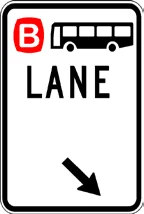
5. When can a private car travel in a lane marked by this sign?Official CG037
Answer: Only within 100 metres of making a turn.
The sign marks a bus lane. Private cars may only use it within 100 metres of making a turn, so that buses keep moving.
6. When merging onto the freeway from the entrance, you should -Official CG052
Answer: Look for a large enough break in the traffic and adjust your speed so as to fit into the traffic flow.
On the entrance ramp, check the gap in traffic and adjust your speed to merge smoothly. Stopping on the ramp or just relying on the horn is dangerous.
7. You are driving on a freeway and realise you forgot something at home. You want to go back for it. Can you do a U-turn on this road?Official CG075
Answer: No, not at any time.
U-turns on a freeway are banned because of fast traffic and no safe place to turn. Carry on to the next exit instead.
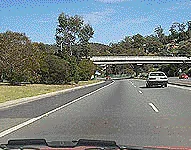
8. When you are driving on a two-lane freeway, which lane should you choose?Official CG105
Answer: The left lane unless you are overtaking.
Keep left unless you are overtaking. This keeps traffic flowing and avoids blocking faster drivers who want to pass.
9. When there are three lanes on a freeway -Official CG106
Answer: The right lane is reserved for overtaking.
On a three-lane freeway, the right lane is for overtaking. Return to the left lane once you've passed.
10. How should you merge with traffic when entering a freeway?Official LD001
Answer: Watch for a gap and merge with the traffic at the speed it is travelling.
Freeway traffic is moving fast, so you need to match its speed and slot into a safe gap. Forcing your way in or stopping to enter would cause crashes.
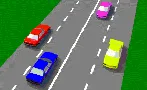
11. When driving in traffic lanes (as shown in the diagram), you may change your lane -Official LD009
Answer: Only when it is safe to do so.
Indicating or honking does not make a lane change safe. You must check that the space is clear before moving across.
12. When two lanes merge into one (as shown in the diagram), who should give way?Official LD010
Answer: The vehicle which has to cross the lane line.
When lanes merge, the driver who has to cross the lane line is the one moving across, so they give way. Being faster or being on the right does not give priority.
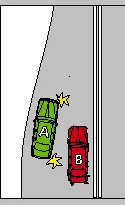
13. Looking at the diagram, which vehicle must give way?Official LD011
Answer: Vehicle B.
Vehicle A is moving across the lane line towards B. The driver changing lanes (crossing the line) must give way, so B has priority.
14. You must use your indicator lights when -Official LD013
Answer: Changing lanes or turning left or right.
Signalling warns others of your plans. You must indicate when changing lanes or turning, not just when you think someone is nearby.
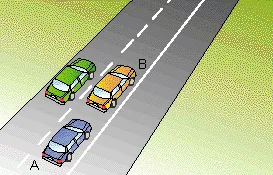
15. You are in car marked A. You wish to overtake car marked B. You should -Official LD015
Answer: Wait behind car B until it moves into the left lane.
Car B is ahead in the right lane, and your lane has a single unbroken line beside it, so you cannot cross. You must wait until B moves left and the lane is open to pass.
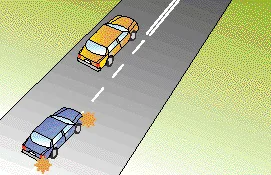
16. When starting to overtake you see the dividing lines ahead change to double unbroken lines. What should you do?Official LD018
Answer: Do not overtake because you are not permitted to overtake on double lines.
If the line becomes unbroken, overtaking is no longer legal, even if you began earlier. Drop back safely behind the vehicle you were passing.
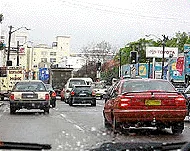
17. Before changing lanes you should -Official LD025
Answer: Signal in plenty of time, check your mirrors and look over your shoulder for other vehicles.
A safe lane change needs warning, a check of mirrors and a look over your shoulder for blind spots. Rushing or speeding up gives others no time to react.
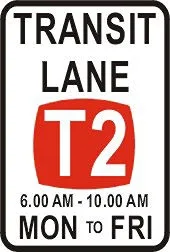
18. You drive into a transit lane where the T2 rule applies. You have one passenger plus yourself. Are you permitted to remain in the transit lane?Official LD026
Answer: Yes, you have two people in your car so you can drive in this lane.
A T2 lane can be used by vehicles carrying at least two people, including the driver. Driver plus one passenger meets the requirement during the hours shown on the sign.
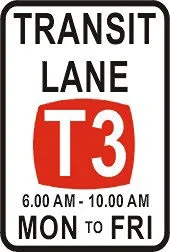
19. You change lanes and then see you are in a lane where the T3 rule applies. There is no other traffic in this lane. You have one passenger. What should you do?Official LD027
Answer: Change lanes as soon as it is safe because you are not permitted to travel in a T3 lane with only two people in your car.
A T3 lane needs at least three people in the vehicle, including the driver. With only two you must leave when it is safe, not stop suddenly.
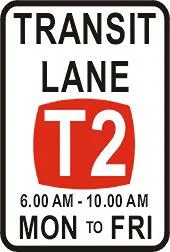
20. You are approaching the start of a T2 transit lane. You are the only person in the car. You want to turn left at the next intersection 200 metres away. Can you travel in the transit lane at this point?Official LD028
Answer: No, because you can only travel in the transit lane if the intersection you are turning left at is within 100 metres.
Without enough occupants, you can enter a transit lane only to turn left within a short distance (100 metres). 200 metres is too far, so you stay out of it.
21. Overtaking another vehicle requires good concentration and judgement. Which of the following statements is correct?Official LD040
Answer: You need to watch out for all large, long vehicles which are turning.
Long vehicles often swing wide when turning, so overtaking them near a turn is risky. Speeding up when you're overtaken is dangerous, and passing a faster vehicle needs more room, not less.
22. When driving on a multi-lane road with a speed limit of more than 80 km/h, which lane should you choose?Official LD041
Answer: The left lane unless overtaking.
On multi-lane roads over 80 km/h you must keep left unless overtaking or turning right. This keeps traffic flowing and stops slower drivers blocking faster ones.
23. Signalling is -Official LD043
Answer: Always required before turning or lane changing.
You must always signal before turning or changing lanes. Others rely on it, even at T-intersections or when following a green arrow.
24. How should you merge with traffic when entering a motorway?Official LD044
Answer: Watch for a gap and increase your speed to safely merge with the traffic.
Motorway traffic moves fast, so you must match its speed and merge into a safe gap. Slowing or stopping on the entry ramp invites a collision.
25. You are approaching a hill or curve. You must not cross the centre line to overtake -Official ND004
Answer: If you do not have a clear view of any approaching traffic.
Never cross the centre line to overtake unless you can see the approaching road is clear. On hills and curves your view is limited, so overtaking is unsafe.
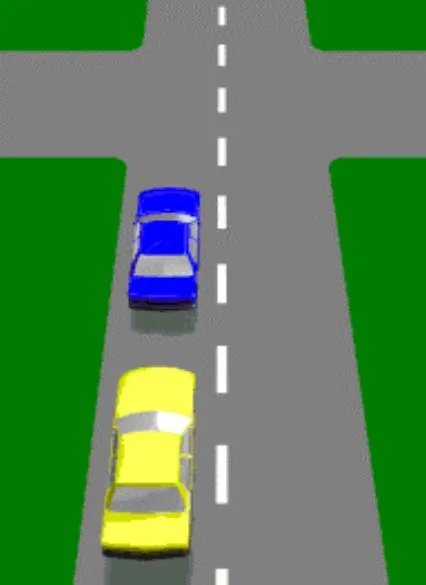
26. On a single laned road (as shown), you must always overtake another vehicle on its right except when -Official ND007
Answer: The other vehicle is turning right.
Normally you pass on the right. The exception is when the vehicle ahead is turning right and has moved to the right side, so you may go past on its left if there's room.
27. When overtaking another vehicle you should NOT move back in front of it, unless –Official ND008
Answer: You can see the overtaken vehicle in your rear vision mirror.
Cutting in too early can clip the vehicle you're passing. Move back in only when you can see it in your rear-vision mirror.
28. A driver behind you signals their intention to overtake your car. What should you do?Official ND009
Answer: Keep to the left and let that driver overtake you.
Move left and let the driver pass safely. Speeding up or signalling them back can cause a collision and is not allowed.
29. The faster the vehicle in front of you is travelling, the -Official ND010
Answer: More distance and time you need to overtake.
The faster the vehicle ahead, the longer it takes to pass it. You need more road distance and time to complete the overtake safely.
30. If you are not sure you have enough distance to overtake a vehicle ahead, you should -Official ND011
Answer: Wait for a better opportunity with more distance to overtake.
If you aren't sure there's enough space, wait for a clearer chance. Honking or speeding up does not make the overtake safer.
31. When being overtaken by another vehicle what should you do to help?Official ND012
Answer: Keep left and allow plenty of room to let the other vehicle back in.
Keep left and leave room so the overtaking driver can move in safely. Braking hard or stopping can lead to a crash.
32. Before beginning to overtake another vehicle, you should -Official ND014
Answer: Check to see it is safe, change gear if necessary, and signal your intention before moving out.
Before moving out, check that the road is clear, change gear if needed and signal. A horn alone doesn't make it safe.
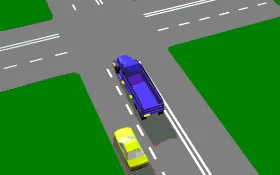
33. You are driving behind a long vehicle (as shown) which has a sign saying DO NOT OVERTAKE TURNING VEHICLE. The long vehicle indicates that it is going to turn left. You –Official ND015
Answer: Must let the long vehicle turn first.
The sign warns drivers not to overtake the vehicle when it is turning. Long vehicles swing wide to the right to turn left, leaving a gap, so you must let it turn first.
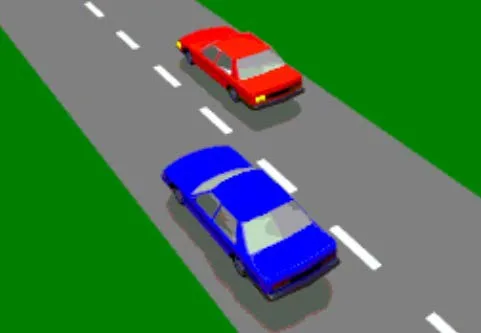
34. If an overtaking vehicle signals that it must move in, in front of you, you should -Official ND020
Answer: Prepare to slow down to allow room.
If an overtaking vehicle signals to move in front of you, ease off and leave room. The red car is ahead of you, so it needs space to merge. Do not speed up or flash it.
35. The first thing you should do before overtaking is -Official ND021
Answer: Make sure it is safe and the way is clear of oncoming traffic.
The first step is to check it's safe and the road ahead is clear of oncoming traffic. Honking or speeding up comes after you know it's safe.
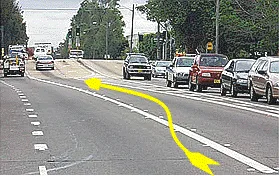
36. You are travelling in the left lane and wish to turn right at the intersection. You move to the right lane and a driver behind sounds their horn at you. What have you done wrong?Official ND031
Answer: Crossed an unbroken lane line.
The unbroken lane line beside you means you can't cross it. You should have been in the right lane before the line began, so the driver honked because of your illegal lane change.
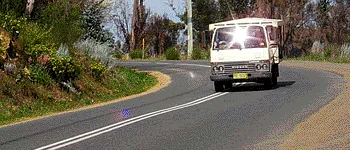
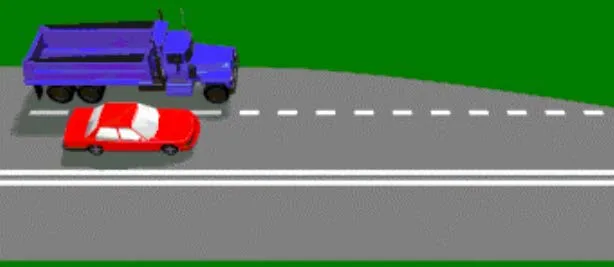
37. What is this driver doing that is negligent and illegal?Official ND032
Answer: Crossing an unbroken line at a curve.
On this curve there is an unbroken line on the truck's side, and the truck is crossing it. It is illegal and negligent because other traffic can't see it in time.
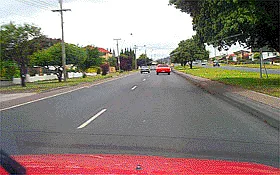
38. The speed limit on this road is 90 km/h. You have just overtaken a vehicle in the left lane. What should you do next?Official ND033
Answer: Move into the left lane.
Having overtaken, return to the left lane when it is safe. On roads over 80 km/h you must keep left unless overtaking.
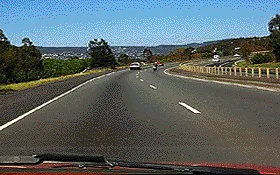
39. The speed limit on this road is 100 km/h. When can you use the right lane?Official ND034
Answer: Only when overtaking or turning right.
On roads over 80 km/h the right lane is only for overtaking or turning right. Otherwise keep left.
40. Another vehicle is overtaking you on your right. You commit a traffic offence if you -Official ND035
Answer: Speed up while the other vehicle is on your right.
You must not speed up when being overtaken. Doing so makes it harder and more dangerous for the other driver and is an offence.
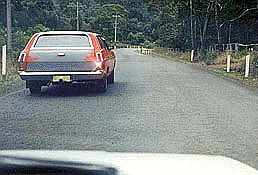
41. When you have started to overtake the car, you notice that its right indicator is flashing. You should -Official ND044
Answer: Check your mirror and move back in behind the car.
The car you're overtaking is indicating right, so it may be about to turn across you. Don't accelerate: check your mirror and drop back in behind it safely.
42. You are driving on a road with a speed limit of 100 km/h. When may you use the right lane?
Answer: When you are overtaking another vehicle
On roads above 80 km/h you must keep left, and may use the right lane only for exceptions such as overtaking or turning right.
NSW Road User Handbook: Keep left unless overtaking
43. On a 110 km/h freeway, which of these is a valid reason to use the right lane?
Answer: You are avoiding an obstruction in the left lane
Avoiding an obstruction is one of the listed exceptions to the keep left rule on roads above 80 km/h.
NSW Road User Handbook: Keep left unless overtaking
44. There is a single continuous white line between you and the oncoming lane. What does it mean for overtaking?
Answer: You must not cross it to overtake
You must not cross a continuous dividing line, single or double, to overtake.
NSW Road User Handbook: Overtaking · Road lines and markings
45. The dividing lines are double, with a broken line closer to you. When can you cross to overtake?
Answer: If the road ahead is clear
You can cross a double line with a broken line closer to you to overtake, provided the road ahead is clear.
NSW Road User Handbook: Overtaking · Road lines and markings
46. In which situation must you not overtake?
Answer: A vehicle ahead is stopping at a pedestrian crossing
You must not overtake a vehicle that is stopping or has stopped at a pedestrian crossing, intersection or railway crossing.
NSW Road User Handbook: Overtaking
47. You are being overtaken on a single-lane road. What should you do?
Answer: Stay in your lane, keep left and do not speed up
You must not increase your speed while the other vehicle is crossing a dividing line to pass, and you should keep left to allow room.
NSW Road User Handbook: Overtaking
48. When is it legal to overtake on the left on a single-lane road?
Answer: When the vehicle ahead is turning right from the centre
Overtaking on the left is allowed when the vehicle ahead is waiting to turn right or make a U-turn from the centre, is stopped, or is on a multi-lane road.
NSW Road User Handbook: Overtaking
49. You have just passed a vehicle. When is it safe to move back into the lane?
Answer: When the passed vehicle is clear in your mirror
Make sure there is enough room that you can see the overtaken vehicle in your mirror, and indicate before returning to your lane.
NSW Road User Handbook: Overtaking
50. A long truck with a 'Do not overtake turning vehicle' sign is turning left on a single-lane road. What should you do?
Answer: Stay behind it until it has finished the turn
A vehicle with that sign may use more than one lane when turning, so you must not overtake on the left and it is safest to wait behind.
NSW Road User Handbook: Overtaking
51. You need to overtake a vehicle that is waiting to turn right and the only way is through a bicycle lane. What is the longest distance you may drive in it?
Answer: 50 metres
You may drive in a bicycle lane for up to 50 metres to overtake a vehicle turning right or making a U-turn. Take extra care for bicycles.
NSW Road User Handbook: Bicycle lanes · Overtaking on the left
52. Which of these vehicles may use a bus lane, in addition to buses?
Answer: Taxis
Taxis, hire cars with HC plates, bicycles and motorcycles may use bus lanes, but rideshare vehicles may not.
NSW Road User Handbook: Bus lanes
53. You are driving a car and want to drop a friend off in a bus lane. What is the rule?
Answer: You must not stop in a bus lane
Only buses at a bus stop, or taxis and chauffeur-driven hire cars picking up or dropping off, can stop in a bus lane.
NSW Road User Handbook: Bus lanes
54. What does the rule say about T-way lanes?
Answer: You must not drive in a T-way lane
T-way lanes are for authorised buses and service vehicles only, and other drivers must not use them.
NSW Road User Handbook: Bus lanes
55. You want to change lanes on a multi-lane road. What must you do?
Answer: Indicate, check mirrors and blind spot, give way
You must indicate and give way to vehicles already in the lane you are moving into.
NSW Road User Handbook: Merging and changing lanes
56. Your lane is ending as you join a motorway. Who has to give way?
Answer: You, to vehicles already in the lane you move into
When your lane ends and you cross a broken line, you give way to vehicles already in that lane and look for a suitable gap.
NSW Road User Handbook: Merging and changing lanes · Motorways and freeways
57. Two lanes reduce to one and there are no road markings. Who gives way?
Answer: The vehicle behind gives way to the vehicle ahead
This is a zipper merge: you give way to the vehicle that is ahead of you.
NSW Road User Handbook: Merging and changing lanes
58. How should you prepare to exit a motorway?
Answer: Move to the exit lane early, slow down and indicate
Get into the exit lane in plenty of time, slow down and indicate before leaving.
NSW Road User Handbook: Motorways and freeways
59. You miss your motorway exit. What should you do?
Answer: Keep going and take the next exit
If you miss your exit, continue driving and use the next one. U-turns and reversing are not allowed on a motorway.
NSW Road User Handbook: Motorways and freeways
60. When may you stop on a motorway?
Answer: Only in an emergency, such as a breakdown
You must not stop or park on a motorway unless it is an emergency, and then you should move to the emergency stopping lane.
NSW Road User Handbook: Stopping on a motorway
61. An overhead lane signal above your motorway lane shows a red cross. What must you do?
Answer: Not drive in that lane, as it is closed
A red cross is a closed-lane signal warning of a hazard ahead. You must not drive in that lane and should move to another when safe.
NSW Road User Handbook: Lane-use signals
Questions people ask
- Can you cross a double white line in NSW?
- It depends which line is closer to you. If a broken line is closer you may cross it to overtake or make a U-turn when it is safe. If a continuous line is closer you cannot overtake or U-turn, but you can cross it to enter or leave the road.
- Do you have to keep left in NSW?
- On roads with a speed limit over 80 km/h, or with a keep left unless overtaking sign, you must not use the right lane except when overtaking, turning right, making a U-turn or another listed exception.
- Who gives way in a zipper merge?
- When lanes reduce and there are no road markings, the vehicle behind gives way to the vehicle ahead of it, so traffic takes turns.
- Can you drive in a bus lane in NSW?
- Other vehicles may use a bus lane to avoid an obstruction, if a sign allows it, or for a maximum of 100 metres to enter or leave the road or overtake a vehicle turning right. You can never stop in a bus lane unless you are a bus at a stop or a taxi picking up or dropping off.
Other DKT topics
- Licences and learner rules
- Penalties and demerit points
- Alcohol and drugs
- Vehicle, seatbelts and towing
- Speed and following distance
- Intersections and give way
- Roundabouts, turning and U-turns
- Sharing the road
- Hazards and emergency vehicles
- Parking
- Phones, distraction and fatigue
- Traffic signs and road markings
Official questions from the NSW Driver Knowledge Test question bank, © State of New South Wales (Transport for NSW), licensed under CC BY 4.0. Answer order changed; explanations by PassRank. Other questions written by PassRank from the rules in the NSW Road User Handbook (© Transport for NSW).