Parking DKT practice
Part 1 and Part 2Free, no account
What you need to know
Parking rules decide where you can stop, for how long and how far you must stay from hazards. Read every sign carefully. A 'No parking' sign means you may only stop briefly to pick up or drop off passengers or goods, while a 'No stopping' sign means you must not stop at all, except in an emergency. Illegal parking can bring a fine and sometimes demerit points.
Many distances are tested. Stay at least 1 m from a fire hydrant and 3 m from double dividing lines or an Australia Post box. Keep 10 m from an intersection without traffic lights and 20 m from one with lights. At pedestrian and children's crossings, keep 20 m before and 10 m after. Near a bus stop it is 20 m before and 10 m after.
Special zones have their own rules. Loading zones suit goods vehicles for up to 30 minutes, bus zones are for public buses, and clearways ban stopping between the signs at the times shown. Pay and time-limit signs, such as '2P meter', tell you how long you can stay and whether you must pay. Resident permit areas need a displayed permit.
When you park, work through your checks. Park parallel to the kerb and in the direction of traffic, leaving at least 1 m from cars in front and behind. Angle parking is at 45 degrees with the front to the kerb. Put the parking brake on, and if you walk more than 3 m away, take the key and lock up. Check mirrors and blind spots before opening your door.
NSW Road User Handbook: No parking · Intersections · Bus stops · Crossings · Fire hydrants · Double dividing lines · Australia Post box · No parking signs · No stopping · Parallel parking · Angle parking · Parking checks · Loading zone · Bus zone · Clearway and special event clearway · On or near a crest or curve · Pay parking
34 practice questions
Pick an answer to see whether it is right and why.
How close can you park to another vehicle when parked parallel to the kerb?
Mark one answer · keys A to D
All the questions with answers
1. How close can you park to another vehicle when parked parallel to the kerb?Official CG016
Answer: You must leave at least 1 metre front and back.
Leave at least 1 metre gap to the vehicles in front and behind when parallel parking, so you and others can get out without bumping anyone.
2. Where there is parallel kerbside parking, are you allowed to double-park alongside a parked vehicle?Official CG017
Answer: No, not at any time.
Double-parking is never allowed, even briefly or for deliveries. It narrows the road, blocks traffic and hides you from other drivers.
3. Are you permitted to park on a median strip or traffic island?Official CG027
Answer: No, not at any time.
Median strips and traffic islands are there to separate traffic and protect pedestrians, so you can never park on them.
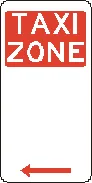
4. Are you permitted to park in the direction of the arrow?Official CG028
Answer: No, not at any time.
The sign marks a Taxi Zone, reserved for taxis picking up and setting down passengers. Other vehicles must not park or stop there, whichever way the arrow points.
5. You see a broken yellow line painted on the roadway adjacent to the kerb. What does it mean?Official CG055
Answer: Clearway restrictions apply - you must not stop during the clearway hours.
A broken yellow line beside the kerb marks a clearway. You must not stop there during the clearway hours, so traffic can flow freely.
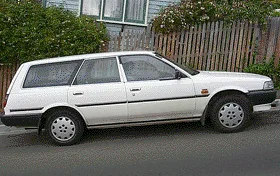
6. You want to leave your automatic car parked on a street sloping uphill. You should -Official CG078
Answer: Put the handbrake on and put the transmission in "P" (park).
Apply the handbrake and select P (Park) so the car cannot roll away. In an automatic the handbrake plus Park is the secure way to hold it on a slope.
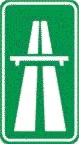
7. You have just passed this sign. Can you park on this road?Official CG080
Answer: No, not at any time.
This freeway sign means no stopping or parking on the freeway, except in an emergency. Cars stopped beside fast traffic are very likely to be hit.
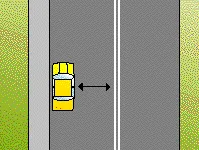
8. Where there are double dividing lines, you may park -Official CG082
Answer: At least three metres from the dividing lines.
The picture shows a car beside double lines. You must leave at least 3 metres clear between your car and the lines, so passing traffic can get by safely.
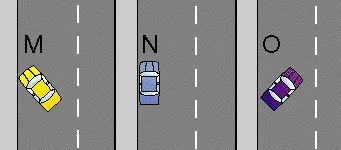
9. If there are no signs or markings to advise you, can you choose any of these methods of parking?Official CG083
Answer: No, only N is correct.
With no signs or markings, park parallel to the kerb as car N does. M and O are angled and would stick out into the traffic lane.
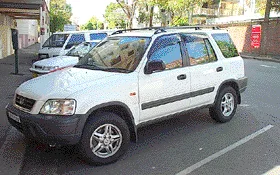
10. You should angle park -Official CG084
Answer: Where there are markings or a sign indicating angle park.
Angle parking is only allowed where signs or markings show it. Otherwise park parallel to the kerb, as angled cars protrude into the road.
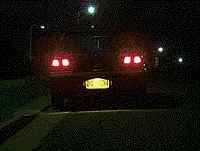
11. You want to park your vehicle for a short time. It is night time. You should -Official CG102
Answer: Pick a visible position or leave the parking or hazard lights on.
When parking at night, choose a spot where other drivers can see your car, or leave parking or hazard lights on. High beam would dazzle and the footpath is no place.
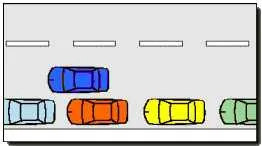
12. You are driving your vehicle along a street and want to stop for a short time. Are you allowed to double park your vehicle (that is stand it on the road alongside a parked car)?Official CG112
Answer: No, never.
The picture shows a car beside parked cars, which is double-parking. It is never allowed, even briefly with hazard lights on, as it blocks traffic.
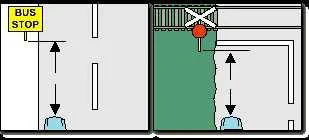
13. Looking at the diagrams, how far from the approach side of a bus stop or a railway crossing are you allowed to stand or park your vehicle?Official CG113
Answer: At least 20 metres.
As the diagrams show, you can't stop or park within 20 metres before a bus stop or a railway crossing, so drivers can see approaching buses or trains.
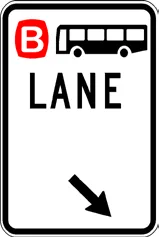
14. You are driving a car and want to pick up a passenger. The lane you want to stop in is a BUS LANE. Are you permitted to stop there?Official LD032
Answer: No, unless you are driving a hire car or a taxi.
Stopping in a bus lane is not allowed for ordinary cars. Taxis and hire cars may stop to pick up or set down passengers, so ordinary drivers must stop elsewhere.
15. You want to stop beside a car that is already parked at the kerb, just for a minute. What is the rule?
Answer: You must not, because that is double parking
Stopping or parking alongside another parked vehicle is double parking and is not allowed.
NSW Road User Handbook: No parking
16. There are no traffic lights at an intersection and no signs. How close may you park to it?
Answer: No closer than 10 m
You must not park within 10 m of an intersection without traffic lights unless a sign says you can.
NSW Road User Handbook: Intersections
17. An intersection has traffic lights. How close may you park to it, unless a sign allows it?
Answer: No closer than 20 m
The no-parking distance is 20 m at an intersection with traffic lights.
NSW Road User Handbook: Intersections
18. Where may you NOT park in relation to a bus stop sign, unless another sign allows it?
Answer: Within 20 m before and 10 m after
The no-parking area runs 20 m before and 10 m after a bus stop.
NSW Road User Handbook: Bus stops
19. You are looking for a space near a pedestrian crossing. Which distances must you leave?
Answer: 20 m before and 10 m after
You must not stop or park within 20 m before and 10 m after a pedestrian crossing or children's crossing unless a sign says you can.
NSW Road User Handbook: Crossings
20. What is the closest you may park to a fire hydrant?
Answer: 1 m away
You must not park within 1 m of a fire hydrant or its indicator.
NSW Road User Handbook: Fire hydrants
21. How close may you park to double dividing lines on the road?
Answer: No closer than 3 m
You must not park within 3 m of any double dividing lines.
NSW Road User Handbook: Double dividing lines
22. You want to post a letter and there is a space right next to an Australia Post box. What does the rule say?
Answer: You may stop to post mail, but not park within 3 m
You must not park within 3 m of an Australia Post letter box, but you may stop to post mail or drop off or pick up passengers.
NSW Road User Handbook: Australia Post box
23. A 'No parking' sign applies to your side of the street. Which of these is allowed?
Answer: Stopping for under 2 minutes, within 3 m of your car, to drop off a passenger
You may stop for less than 2 minutes within 3 m of your vehicle to pick up or drop off passengers or load and unload.
NSW Road User Handbook: No parking signs
24. A continuous yellow edge line along the kerb is sometimes used to mark which kind of area?
Answer: A no stopping area
No stopping areas are sometimes marked by a continuous yellow edge line. You must not stop there unless in an emergency.
NSW Road User Handbook: No stopping
25. You are parallel parking behind another car. What gap must you leave in front of and behind your vehicle?
Answer: At least 1 m
When parallel parking you must be at least 1 m from any other parked vehicle in front and behind.
NSW Road User Handbook: Parallel parking
26. Line markings show you can angle park. Unless a sign says otherwise, how must you park?
Answer: At 45 degrees with the front of the car to the kerb
Angle parking is at a 45-degree angle with the front of the vehicle to the kerb.
NSW Road User Handbook: Angle parking
27. You are leaving your car and will be more than 3 m away from it, with nobody inside. What must you do?
Answer: Set the parking brake, take the key and lock up
The parking brake must always be on. Beyond 3 m you must also remove the key and lock up if no-one is in the vehicle.
NSW Road User Handbook: Parking checks
28. What must you do before opening your car door onto the road side?
Answer: Check your mirrors and blind spots
You must check mirrors and blind spots before opening a door, to avoid hitting someone passing by.
NSW Road User Handbook: Parking checks
29. You are about to pull out from a parallel parking space. How long must you indicate?
Answer: At least 5 seconds
Before pulling out from the side of the road you must indicate for at least 5 seconds, check mirrors and look over your shoulder.
NSW Road User Handbook: Parking checks
30. A loading zone sign applies at the kerb. Who may stop there for up to 30 minutes to load goods?
Answer: Vehicles primarily designed to carry goods
Vehicles built mainly to carry goods can stop for up to 30 minutes to load or unload. Any vehicle can stop briefly for passengers.
NSW Road User Handbook: Loading zone
31. A bus zone sign shows an arrow pointing to the left, with no times. Who may stop there?
Answer: A public bus only
In a bus zone you must not stop unless you are driving a public bus.
NSW Road User Handbook: Bus zone
32. You are on a road with a 'Clearway' sign, within the times shown. What is the rule?
Answer: You must not stop or park, unless in an emergency
Between the clearway signs at the times shown you must not stop or park, unless in an emergency.
NSW Road User Handbook: Clearway and special event clearway
33. You are outside a built-up area on a curve. When may you stop your car there?
Answer: If other drivers can see your car from 100 m away
Outside built-up areas you must not stop on a hill or curve unless drivers can see your vehicle from at least 100 m away.
NSW Road User Handbook: On or near a crest or curve
34. A sign reads '2P meter'. What does it tell you?
Answer: You can stay up to 2 hours, paying at the meter
A '2P meter' sign means you can stay up to 2 hours and you must pay at the meter.
NSW Road User Handbook: Pay parking
Questions people ask
- How far from an intersection can I park in NSW?
- You must not park within 10 m of an intersection without traffic lights, and not within 20 m of one with traffic lights, unless a sign says you can. The T-intersection exception lets you park along the continuous side of the road.
- How close can I park to a fire hydrant in NSW?
- You must not park within 1 m of a fire hydrant, a fire hydrant indicator or a fire plug indicator.
- What is the difference between 'No parking' and 'No stopping' signs?
- At a 'No parking' sign you can stop for less than 2 minutes, staying within 3 m of your vehicle, to pick up or drop off passengers or load and unload. At a 'No stopping' sign you must not stop at all, unless in an emergency.
- How far can I walk from my car before I must lock it in NSW?
- If you move more than 3 m away from your vehicle, you must remove the key and lock all doors and windows if nobody is inside. Always apply the parking brake before leaving.
Other DKT topics
- Licences and learner rules
- Penalties and demerit points
- Alcohol and drugs
- Vehicle, seatbelts and towing
- Speed and following distance
- Intersections and give way
- Roundabouts, turning and U-turns
- Lanes, overtaking and merging
- Sharing the road
- Hazards and emergency vehicles
- Phones, distraction and fatigue
- Traffic signs and road markings
Official questions from the NSW Driver Knowledge Test question bank, © State of New South Wales (Transport for NSW), licensed under CC BY 4.0. Answer order changed; explanations by PassRank. Other questions written by PassRank from the rules in the NSW Road User Handbook (© Transport for NSW).