Speed and following distance DKT practice
Part 1 and Part 2Free, no account
What you need to know
Where there is a speed sign, that number is your maximum in good conditions. Where there is none, the default applies: 50 km/h in built-up areas (street lights with buildings less than 100 m apart) and 100 km/h on every other road. Your licence adds its own cap. Learners and P1 drivers may not exceed 90 km/h and P2 drivers may not exceed 100 km/h, even when the sign shows a higher figure.
Some areas have special limits. Local traffic areas are 40 km/h and shared zones are 10 km/h, where you must also give way to pedestrians. School zones apply the limit shown on the sign during the times posted, and roadworks signs set their own limits. When a school bus has its top lights flashing, you may not pass it at more than 40 km/h. Advisory signs have a yellow background and only recommend a speed.
Speed and space go together. Your crash avoidance space is the gap that gives you time to see a problem, decide and brake. In good conditions you need at least 3 seconds behind the vehicle in front. To check it, pick a roadside marker, count as the vehicle ahead passes it, and make sure you reach it after the count. If you arrive early, ease off and count again.
Conditions change the numbers. On wet roads, unsealed roads, in the dark or in ice, stretch the gap to 4 seconds or more, brake gently and turn on your headlights. Even driving 5 km/h over the limit takes you much further to stop, because stopping distance grows quickly with speed. You can be booked for speeding, and you can also be driving too fast for the conditions while still under the limit.
NSW Road User Handbook: Speed limits · Crash avoidance space · Driving in poor conditions
45 practice questions
Pick an answer to see whether it is right and why.
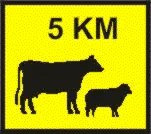
You hold an unrestricted licence and are driving at 100 km/h in the country and pass this sign. What should you do?
Mark one answer · keys A to D
All the questions with answers
1. You hold an unrestricted licence and are driving at 100 km/h in the country and pass this sign. What should you do?Official CG070
Answer: Slow down to a speed that will allow you to stop to avoid crashing into farm animals on the road.
The sign warns farm animals may be on the road, so slow down enough to stop if animals appear. Fences don't remove the risk, and there is no automatic 60 km/h limit.
2. Under good conditions, when driving behind any vehicle, at any speed, you should -Official FD001
Answer: Stay at least three seconds behind the vehicle in front of you.
Keeping at least a three-second gap gives you time to notice and react if the vehicle ahead brakes. Following closely or at only one second leaves too little time to stop.
3. At night you should -Official FD011
Answer: Leave a longer gap behind the vehicle in front.
At night it is harder to judge distance and spot hazards, so leave a bigger gap behind the vehicle in front to give yourself more time to react.
4. You are driving an older relative for an appointment and are running late. They ask you to go faster to get there on time. You should -Official FD035
Answer: Choose a safe speed and say you will not go any faster.
You are responsible for driving at a safe speed. Passengers' pressure or running late is no reason to speed, so politely say you will keep to a safe speed.
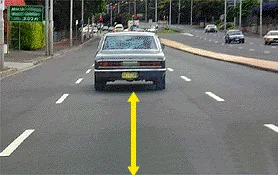
5. You should leave a gap between your vehicle and the one you are following. In good conditions the gap should be -Official FD037
Answer: 3 seconds.
A three-second gap in good conditions gives you time to react and stop if the vehicle ahead brakes suddenly. Pick a fixed point and count the seconds after the vehicle in front passes it.
6. It is night time and you are driving home from the movies. You are travelling in a line of vehicles. What size gap should you leave between your vehicle and the vehicles in front of you?Official FD038
Answer: A gap of about 4 seconds as it is easy to misjudge distances at night.
At night it is harder to judge distances and speeds, so you need extra time to react. About four seconds gives a safer buffer than the usual three seconds.
7. If the police suspect you may have been involved in street or drag racing, they may take immediate action. Which one of the following is correct? The police may -Official ND038
Answer: Take your vehicle from you and keep it stored for up to three months.
Police can impound a street racing vehicle and keep it for up to three months. This helps stop dangerous racing on public roads.
8. If you are convicted a second time for street or drag racing, which one of the following penalties applies?Official ND039
Answer: Your vehicle may be taken away and sold.
On a second street-racing conviction your vehicle can be taken away and sold. This stops repeat offenders.
9. If you have been convicted for street or drag racing, which of these penalties may apply?Official ND040
Answer: You will get three demerit points and a large fine.
Street and drag racing are treated as very serious offences. A conviction can bring demerit points and a large fine, plus other penalties.
10. If you are caught speeding through a road work zone you will -Official ND045
Answer: Be liable for a speeding fine and loss of demerit points.
Road-work speed limits are enforced like any other limit. You can be fined and lose demerit points, and the penalties are heavier in work zones.
11. When driving through temporary road work you should -Official ND046
Answer: Slow down and look out for hazards.
Roadworks bring workers, narrower lanes, uneven surfaces and changing signs. Slow down and watch for hazards.
12. Will a P1 licence be suspended for any speeding offence?Official ND048
Answer: Yes.
Any speeding offence by a P1 driver, even a few km/h over the limit, means the licence is suspended for at least three months.
13. Driving faster than the maximum speed limit is -Official SL007
Answer: Never legally permitted.
The speed limit is a legal maximum at all times. Other traffic speeding or overtaking does not make exceeding it lawful.
14. A Shared Traffic Zone, where pedestrians and other road users can share the road safely has a speed limit of -Official SL015
Answer: 10 Km/h.
A Shared Zone has a 10 km/h limit because pedestrians have priority and can walk anywhere on the road. You must give way to them.
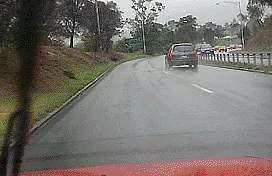
15. You are driving in busy traffic in an 80 km/h zone. It begins to rain lightly. What should you do?Official SL021
Answer: Slow down to a speed that suits the conditions better.
The posted limit is the maximum in good conditions. In rain the road is slippery and visibility is worse (the picture shows a wet road), so slow down and leave a bigger gap.
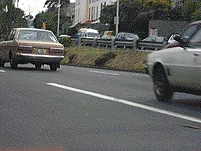
16. You are driving in a 70 km/h zone, keeping to the limit. Several vehicles pass you. One of your passengers suggests you should keep up with the other traffic. What should you do?Official SL022
Answer: Decide your speed yourself, based on the speed limit and the conditions.
You are responsible for your own speed. Never go over the limit because others do. Choose a speed that suits the limit and the conditions, whatever other drivers or passengers say.
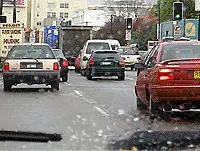
17. You are driving in busy traffic in a 60 km/h zone. You feel 60 km/h is a bit too fast for the conditions. What should you do?Official SL023
Answer: Slow down to a speed that suits the conditions.
The limit is a maximum, not a target. If busy traffic makes 60 km/h feel too fast, you must slow to a speed you can safely control.
18. What could be the penalties for driving over the speed limit -Official SL025
Answer: Fines, demerit points and possibly loss of licence.
Speeding can bring a fine, demerit points and licence suspension or loss, particularly for repeat or serious offences. It is treated seriously because speed causes crashes.
19. Having a radar detector or jammer in your car is against the law -Official SL026
Answer: No matter what your reason is.
Radar detectors and jammers are illegal to have in a vehicle in NSW, whether or not they are switched on and whatever the reason for having one.
20. Where there are no speed limit signs, the speed limit is 100 km/h, unless -Official SL028
Answer: There are street lights along the road.
With no signs, the default limit in NSW is 100 km/h on open road, but 50 km/h in built-up areas. Street lights are the clue that you are in a built-up area.
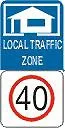
21. When you see this sign you must -Official SL030
Answer: Not exceed 40 km/h and keep a special lookout for bicycle riders, pedestrians and children.
A Local Traffic Zone sign with 40 means a 40 km/h limit. Anyone may drive in, but expect cyclists, pedestrians and children using the street.
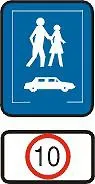
22. This sign means you must -Official SL031
Answer: Share this road with other people and vehicles and not exceed 10 km/h.
A Shared Zone sign with a 10 limit means pedestrians, vehicles and cyclists share the space. Keep to 10 km/h or less and give way to pedestrians.
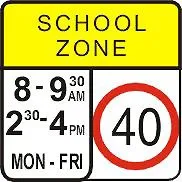
23. It is 9.20am on a school day. You are driving at 60 km/h, the same speed as traffic around you. You pass this sign but the other cars do not slow down much. What should you do?Official SL032
Answer: Slow down immediately to 40 km/h or less even though other drivers want to go faster.
The sign shows a school zone 8-9:30am and 2:30-4pm on weekdays, so at 9:20am the 40 km/h limit applies. Other drivers' speed is no excuse.
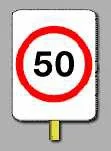
24. Speed limit signs (such as the one shown) tell drivers -Official SL034
Answer: The maximum speed they are allowed to drive.
A red-circle speed sign is a legal limit, not advice. It is the maximum speed allowed, and conditions may require you to go slower.
25. If you are driving along the highway and come across road works with a reduced speed zone, you must -Official SL035
Answer: Slow down to the new speed limit.
Roadworks speed limits protect workers and deal with uneven or narrowed roads. You must slow to the posted limit as soon as you reach the sign.
26. You are on a street with street lights and houses close together, and there is no speed sign. What is the speed limit?
Answer: 50 km/h
The default limit in a built-up area, where street lights and buildings are close along the road, is 50 km/h.
NSW Road User Handbook: Speed limits
27. You are on a country road with no speed signs, no street lights and no buildings nearby. What is the default speed limit?
Answer: 100 km/h
On roads outside built-up areas without a sign, the default limit is 100 km/h.
NSW Road User Handbook: Speed limits
28. You hold a learner licence and drive on a highway signed 110 km/h. What is the fastest you may legally go?
Answer: 90 km/h
Learners may not drive faster than 90 km/h, even when the sign allows more.
NSW Road User Handbook: Speed limits
29. You are a P2 driver on a freeway signed 110 km/h. What is the highest speed your licence allows?
Answer: 100 km/h
P2 drivers are limited to 100 km/h, even where the sign shows a higher speed.
NSW Road User Handbook: Speed limits
30. You are a P1 driver on a road signed 100 km/h. A friend says you can do 100 because it is the limit. Who is right?
Answer: Your friend is wrong, as P1 drivers are capped at 90 km/h
P1 drivers must not exceed 90 km/h, whatever the sign says.
NSW Road User Handbook: Speed limits
31. What is the speed limit in a local traffic area?
Answer: 40 km/h
A local traffic area is a group of local streets with a 40 km/h limit.
NSW Road User Handbook: Speed limits
32. You enter a shared zone. What is the speed limit, and who has priority?
Answer: 10 km/h, and you give way to pedestrians
Shared zones have a 10 km/h limit and you must give way to any pedestrian, stopping if necessary.
NSW Road User Handbook: Speed limits
33. When does the lower speed limit in a school zone apply?
Answer: On school days, during the times on the sign
The school zone limit applies on school days during the times shown on the sign, so read the sign each time.
NSW Road User Handbook: Speed limits
34. A school bus ahead has the lights on its roof flashing. What is the most you may do when passing it?
Answer: 40 km/h
You must not pass or overtake a school bus at more than 40 km/h while its top lights are flashing.
NSW Road User Handbook: Speed limits
35. You see a yellow sign showing 35 below a curve warning. What does it mean?
Answer: It is the suggested top speed for the curve
Yellow advisory speed signs are not regulatory. They recommend a maximum for average vehicles in good conditions.
NSW Road User Handbook: Speed limits
36. What does a speed sign with a white background and a red circle tell you?
Answer: The maximum speed you must not exceed
A regulatory speed sign shows the limit you must not exceed.
NSW Road User Handbook: Speed limits
37. In good conditions, what is the minimum gap you should keep behind the vehicle in front?
Answer: At least 3 seconds
Keep at least 3 seconds between you and the vehicle in front to have time to react and respond.
NSW Road User Handbook: Crash avoidance space
38. It is raining and the road is wet. How should you change your following gap?
Answer: Increase it to 4 seconds or more
Poor conditions such as wet or icy roads and night driving call for a gap of 4 seconds or more.
NSW Road User Handbook: Crash avoidance space · Driving in poor conditions
39. The car ahead passes a power pole and you reach it only 2 seconds later. What should you do?
Answer: Ease off and count again until you have 3 seconds
If you reach the marker before you finish counting to 3, you are following too closely, so ease off and repeat the count.
NSW Road User Handbook: Crash avoidance space
40. About how long does a fit, alert driver need to react to a hazard in normal conditions?
Answer: About 1.5 seconds
A driver who is alert and unaffected by drugs, alcohol or fatigue needs about 1.5 seconds to react, and at least 1.5 more to respond.
NSW Road User Handbook: Crash avoidance space
41. You are driving 5 km/h over the limit and think it makes little difference. What is the truth about stopping?
Answer: You need much further to stop, even if you brake hard
Even a small increase in speed means you need a much longer distance to stop, wet or dry.
NSW Road User Handbook: Crash avoidance space
42. It starts to rain while you are driving. What should you do?
Answer: Turn on headlights, brake gently and leave more room
In rain, switch on your headlights, brake gently and give yourself a bigger gap, because the road is slippery and stopping takes longer.
NSW Road User Handbook: Driving in poor conditions
43. You are travelling exactly at the speed limit in heavy rain and thick fog. Is that always safe?
Answer: No, the limit is for good conditions, so slow down
Speed signs show the maximum in good conditions. In poor conditions you should drive slower.
NSW Road User Handbook: Speed limits
44. You pass an 'end speed limit' sign on a road outside a town. What limit applies now?
Answer: The default limit, which is 100 km/h here
After an end speed limit sign, the default limit applies, which is 100 km/h outside built-up areas.
NSW Road User Handbook: Speed limits
45. You are a learner and approach roadworks with a sign showing 40. What speed may you drive?
Answer: No more than 40 km/h
Roadwork speed signs are regulatory, so you must not go faster than the speed shown.
NSW Road User Handbook: Speed limits
Questions people ask
- What is the speed limit for P1 drivers in NSW?
- P1 drivers must not drive faster than 90 km/h, even on roads signed 100 km/h or 110 km/h. Learner drivers have the same 90 km/h cap, while P2 drivers can drive up to 100 km/h.
- What is the default speed limit in NSW if there is no sign?
- It is 50 km/h in built-up areas, where there are street lights and buildings less than 100 metres apart, and 100 km/h on all other roads.
- What is the 3-second rule?
- It means staying at least 3 seconds behind the vehicle in front so you have time to react and brake. Increase it to 4 or more seconds on wet, dirt or icy roads and at night.
- How fast can I go past a school bus with flashing lights?
- No faster than 40 km/h while the lights on top of the bus are flashing. This applies when passing or overtaking it in either direction in a school bus stop zone, and when overtaking a bus with a '40 when lights flash' sign.
Other DKT topics
- Licences and learner rules
- Penalties and demerit points
- Alcohol and drugs
- Vehicle, seatbelts and towing
- Intersections and give way
- Roundabouts, turning and U-turns
- Lanes, overtaking and merging
- Sharing the road
- Hazards and emergency vehicles
- Parking
- Phones, distraction and fatigue
- Traffic signs and road markings
Official questions from the NSW Driver Knowledge Test question bank, © State of New South Wales (Transport for NSW), licensed under CC BY 4.0. Answer order changed; explanations by PassRank. Other questions written by PassRank from the rules in the NSW Road User Handbook (© Transport for NSW).