Roundabouts, turning and U-turns DKT practice
Part 1 and Part 2Free, no account
What you need to know
At a roundabout the rule is simple: slow down or stop and give way to every vehicle already on it. That includes traffic on your right and vehicles that entered from your left or from directly opposite you. Once there is a safe gap you go, but you never force your way in. Expect to be asked about this in the Driver Knowledge Test, usually as a short scenario.
Signalling tells other drivers what you plan to do. Turning left, you indicate left and use the left lane. Turning right or making a U-turn, you indicate right, use the right lane and keep the signal on while you go round. When you leave, indicate left if it is practical, then switch the indicator off as soon as you are out. On multi-lane roundabouts, follow the arrows and signs.
Turning at ordinary intersections follows the same idea of being in the right place early. For a left turn, keep close to the left and use a slip lane if there is one, giving way to traffic in the road you join. For a right turn, stay in your lane and move close to the dividing line. Before pulling out from the side of the road, indicate for at least 5 seconds.
U-turns need extra care. You must not make one across a continuous dividing line, on a motorway or freeway, or at traffic lights unless a sign permits it. Start from the lane nearest the centre of the road, have a clear view and give way to vehicles and pedestrians. If the road is too narrow, a three-point turn is the option, but in heavy traffic it is safer to go around the block.
NSW Road User Handbook: Roundabouts · Indicating · Bicycles and roundabouts · Slip lanes · Turning left and right · U-turns and three-point turns
44 practice questions
Pick an answer to see whether it is right and why.
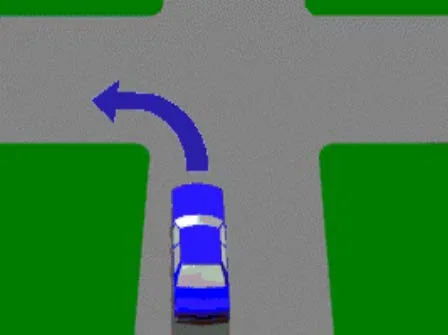
If you intend to turn left, are you required to give a signal?
Mark one answer · keys A to D
All the questions with answers
1. If you intend to turn left, are you required to give a signal?Official CG010
Answer: Yes, if turn signals are fitted to your vehicle.
You must signal a left turn if your vehicle has indicators, even from a left-turn-only lane or where arrows are painted. Signalling warns drivers and pedestrians around you what you will do.
2. You should use your right-hand indicator when -Official CG049
Answer: You intend to move to the right, at any time.
Signal right whenever you intend to move or turn right, at any time. Slowing or stopping alone is shown by brake lights, not by indicators.
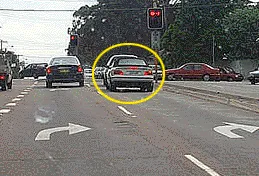
3. You are turning right from one of two right turn only lanes. How should you use your indicators?Official CG071
Answer: Indicate with your right hand signal the same as any other right hand turn.
Even from a dedicated right-turn lane you must signal right. Other road users can't know which way you will go, and the signal helps those beside you.
4. Right-turns must be made from which lanes when travelling on a laned roadway?Official IN008
Answer: The far right-hand lane or any other lane having an arrow pointing right.
On a laned road, turn right from the far right lane or from any lane marked with a right-pointing arrow. Turning from other lanes puts you in conflict with traffic in the lanes beside you.
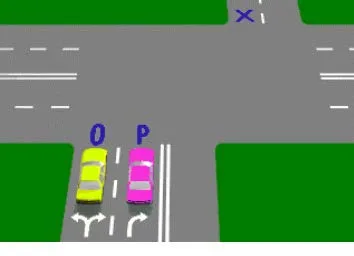
5. If both vehicles P and O in the diagram are turning right, which vehicle is in the best position to turn left into the street marked 'X'?Official IN012
Answer: Vehicle O.
O can turn right into the left lane of the new road, which puts it in place to turn left into X straight after. P would end up in the right lane and have to cross over.
6. You want to make a left turn. You must use your left-hand indicator -Official IN018
Answer: At all times.
Always signal before turning, whatever the road markings or traffic. Your signal warns drivers, riders and pedestrians who you cannot see or who cannot see you.
7. You wish to make a right-hand turn from a ONE WAY STREET with no arrows marked on the roadway. You should position your vehicle -Official IN020
Answer: On the right-hand side of the street.
From a one-way street, with no arrows, position yourself on the right-hand side and turn right from there. Turning from elsewhere can cut across other vehicles.
8. When there are no arrows marked on the road, left turns must be made from -Official IN023
Answer: The far left-hand side of the road.
With no arrows, turn left from the far left of the road. This keeps you away from other lanes and stops vehicles undertaking you.
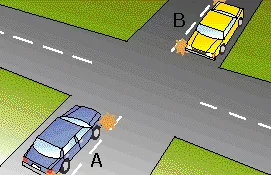
9. You are in car A and want to turn right at this intersection. Car B facing you is also indicating to turn right. What path should you take?Official IN049
Answer: Both pass in front of each other.
Two drivers turning right from opposite directions should each pass in front of the other, right side to right side, so that they can see each other and avoid colliding.
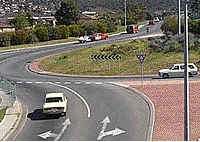
10. You wish to turn left at this roundabout. Which lane may you use?Official IN056
Answer: Left lane.
Turning left at a roundabout, use the left lane and signal left from entry to exit. In this picture the left lane has a left-turn arrow.
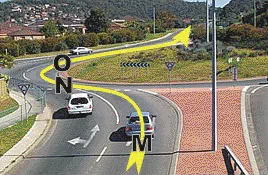
11. You are in the right hand lane and are planning to go straight ahead through this roundabout. When should you signal left to exit the roundabout?Official IN057
Answer: After point O.
Signal left after you pass the exit before the one you want. Signalling too early confuses other drivers, who may think you are leaving earlier than you are.
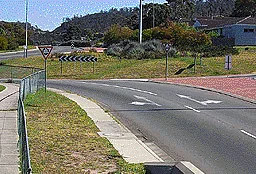
12. When you wish to turn left at a roundabout you indicate -Official IN058
Answer: Left from start to finish.
When turning left at a roundabout, signal left from entering to exiting, so drivers waiting to enter know you are leaving at the first exit.
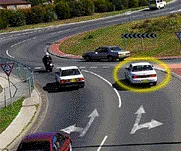
13. You wish to go straight ahead at this roundabout. Which statement is true?Official IN059
Answer: You must leave the roundabout in the same lane as you entered.
Going straight ahead, you keep in the lane you entered by. Changing lanes inside a roundabout is dangerous.
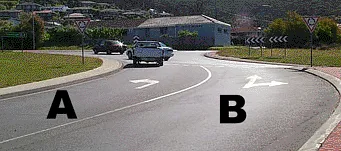
14. You want to turn left at this roundabout. Which lane must you use?Official IN060
Answer: Lane A.
To turn left at a roundabout, use the left lane. Here Lane A has the left arrow, while B is the lane for going straight ahead or right.
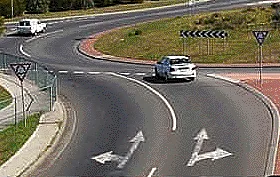
15. When you wish to drive straight ahead at a roundabout you may enter from either the left or right lane. As you continue around you should -Official IN061
Answer: Keep in the lane you entered the roundabout.
Going straight through a roundabout, stay in the lane you entered by from entry to exit. Changing lanes inside risks a side-on collision.
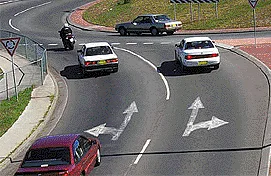
16. When turning left at a roundabout you should enter and leave the roundabout -Official IN062
Answer: In the left lane.
When turning left at a roundabout, enter and leave in the left lane. Staying in one lane keeps your path clear of others.
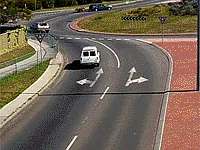
17. You wish to go straight ahead on this roundabout with two lanes. Which lane may you use?Official IN063
Answer: Either lane.
Both lanes can go straight ahead here: the left lane arrow shows left and straight, the right lane arrow shows straight and right. Choose either and stay in it.
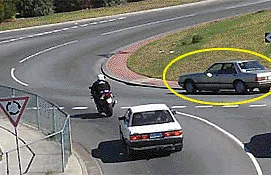
18. The motorcyclist wants to travel straight ahead through this roundabout. The rider should watch out for the marked car because the car -Official IN064
Answer: May be leaving the roundabout.
A car on the roundabout may be about to exit across the motorcyclist's path, so the rider should watch for it and be ready to give way or brake.
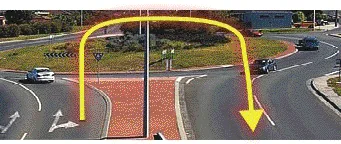
19. To turn back into the same road from which you joined this roundabout you must -Official IN065
Answer: Stay in the right lane all the way round.
To go back the way you came, stay in the right lane all the way round the roundabout and signal right until you exit. Do not cross to the left lane on the way.
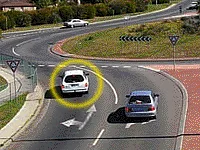
20. In this roundabout with two lanes, can the marked car turn right?Official IN066
Answer: No, not at any time.
This car is in the left lane with a left or straight arrow, so it cannot turn right from there. Right turns must be made from the right lane.
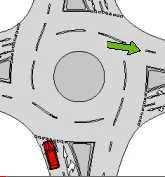
21. The red car wants to turn right and exit the roundabout in the street indicated by an arrow. Is the car positioned in the correct lane to do this?Official IN067
Answer: No, the car should enter the roundabout only from the right hand lane.
To turn right at a multi-lane roundabout, enter from the right-hand lane. The red car is in the left lane, which is not correct for a right turn.
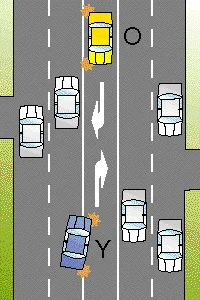
22. You are in car marked Y and want to turn right using a median turning lane. A car marked O, coming towards you, is already in the median lane; it is slowing down and indicating. Are you permitted to enter and share the median turning lane?Official LD029
Answer: Yes, but you must be prepared to slow down and stop.
Cars from both directions can share a median turning lane, but only to turn into a side road or driveway. Be ready to slow or stop for the other car.
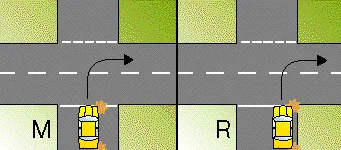
23. You are going to turn right from a one-way street. Where should you be when you start your turn?Official LD038
Answer: Position R. As close as possible to the right side of the road.
In a one-way street you turn right from the right-hand side, as close to the right edge as practical. Position R keeps you out of the way of traffic going straight.
24. Are you permitted to make a U-Turn at traffic lights?Official TL005
Answer: No, unless there is a U-TURN PERMITTED sign at the intersection.
U-turns at traffic lights are banned unless a U-turn permitted sign says otherwise. The sign shows where it is safe and lawful.
25. You are approaching a roundabout. Who must you give way to?
Answer: Every vehicle already on the roundabout
You must slow down or stop and give way to every vehicle already on the roundabout, not just traffic on your right.
NSW Road User Handbook: Roundabouts
26. You want to turn left at a multi-lane roundabout and there are no arrows on the road. Which lane should you approach in?
Answer: The left lane
Unless arrows show other lanes can be used, you approach in the left lane and indicate left to turn left.
NSW Road User Handbook: Roundabouts
27. You are turning right at a roundabout. How should you signal?
Answer: Right on approach and as you turn, then left to leave
Keep the right indicator on as you turn, then indicate left to leave if it is practical.
NSW Road User Handbook: Roundabouts
28. You are going straight ahead at a large roundabout. What should you do as you leave?
Answer: Indicate left if it is practical to do so
When leaving a roundabout you should signal left if it is practical, so drivers waiting to enter know your intention.
NSW Road User Handbook: Roundabouts
29. When should you stop indicating after leaving a roundabout?
Answer: As soon as you have left it
Switch the indicator off as soon as you have exited so you do not confuse other road users.
NSW Road User Handbook: Roundabouts · Indicating
30. You are on a multi-lane roundabout with arrows painted on the road. What must you do?
Answer: Follow the direction of the arrows or signs
On multi-lane roundabouts you must follow the arrows or signs showing which lane goes where.
NSW Road User Handbook: Roundabouts
31. You are inside a multi-lane roundabout and need to move into the next lane. When is it allowed?
Answer: Only across a broken line, giving way first
You can only change lanes across a broken white line, never a continuous one, and you must give way to vehicles in the lane you move into.
NSW Road User Handbook: Roundabouts
32. You turn left at a roundabout and a pedestrian is walking across the exit road, with no pedestrian crossing there. What is the rule?
Answer: You need not give way, but must avoid hitting them
Without a pedestrian crossing you are not required to give way, but you must always take care not to collide with a pedestrian.
NSW Road User Handbook: Roundabouts
33. A bicycle rider is stopped in the left lane of a multi-lane roundabout. What might they be doing?
Answer: Turning right from the left lane, giving way to leavers
Bicycle riders may use the left lane to turn right at a multi-lane roundabout, and they must give way to vehicles that are leaving it.
NSW Road User Handbook: Bicycles and roundabouts
34. There is a slip lane at the intersection where you want to turn left. What must you do?
Answer: Use the slip lane to make the turn
You must use a slip lane to turn where one is provided, whether or not there is a Give way sign.
NSW Road User Handbook: Slip lanes
35. You are turning left in a slip lane. Which of these must you give way to?
Answer: Vehicles on the road you join and oncoming right-turners
In a slip lane you give way to vehicles on the road you are entering, oncoming vehicles turning right into it, and anyone else in the slip lane.
NSW Road User Handbook: Slip lanes
36. Can you stop in a slip lane to let a passenger out?
Answer: No, unless a parking sign allows it
You must not stop in a slip lane unless a sign allows parking there.
NSW Road User Handbook: Slip lanes
37. You are on a multi-lane road and want to turn left at the next intersection. Where should you turn from?
Answer: The left lane, or a lane with a left arrow
On a multi-lane road you turn left from the left lane or from a lane marked with a left arrow.
NSW Road User Handbook: Turning left and right
38. What must you do when making a right turn?
Answer: Indicate right and stay in your lane through the turn
You indicate right, follow any lane markings or arrows, and stay in the same lane as you turn from one road to the other.
NSW Road User Handbook: Turning left and right
39. When turning left or right, how far may you drive on, across or outside the edge lines if necessary?
Answer: Up to 100 metres
If necessary you may drive on, across or outside edge lines for up to 100 metres when turning.
NSW Road User Handbook: Turning left and right
40. You are parked at the kerb and about to pull out into traffic. For how long must you indicate first?
Answer: At least 5 seconds
Before pulling out from the side of the road or a parking area you must indicate for at least 5 seconds.
NSW Road User Handbook: Indicating
41. You are making a U-turn on a road with marked lanes. Where must you start from?
Answer: The lane nearest the centre of the road
A U-turn starts from the marked lane nearest the centre of the road, with a clear view of approaching traffic and without blocking anyone.
NSW Road User Handbook: U-turns and three-point turns
42. In which of these places is a U-turn not allowed?
Answer: Across a single continuous dividing line
You cannot make a U-turn across a single or double continuous dividing line, or on a motorway or freeway.
NSW Road User Handbook: U-turns and three-point turns
43. You are at an intersection with traffic lights and no signs about U-turns. Can you make a U-turn?
Answer: No, unless a 'U-turn permitted' sign is shown
At intersections with traffic lights a U-turn is only allowed where a 'U-turn permitted' sign is shown.
NSW Road User Handbook: U-turns and three-point turns
44. The road is too narrow for a U-turn, but it is busy with traffic. What is the safer choice?
Answer: Go around the block or use a roundabout
A three-point turn takes longer than a U-turn, so in heavy traffic it is safer to go around the block or use a roundabout.
NSW Road User Handbook: U-turns and three-point turns
Questions people ask
- Who has right of way at a roundabout in NSW?
- Vehicles already on the roundabout have right of way. You must slow down or stop and give way to them, including vehicles that entered from your left or from directly opposite you.
- Do you have to indicate when leaving a roundabout in NSW?
- Yes, you should indicate left when you exit if it is practical to do so. On a small single-lane roundabout when going straight ahead, it may not be practical. Turn the indicator off as soon as you have left.
- How long must you indicate before pulling out from the kerb?
- You must indicate for at least 5 seconds before pulling out from the side of the road or a parking area. Always check your mirrors and blind spot as well.
- Where is a U-turn not allowed in NSW?
- You cannot make a U-turn across a continuous dividing line, on a motorway or freeway, or where a No U-turn sign is displayed. At traffic lights you may only U-turn if a U-turn permitted sign is shown.
Other DKT topics
- Licences and learner rules
- Penalties and demerit points
- Alcohol and drugs
- Vehicle, seatbelts and towing
- Speed and following distance
- Intersections and give way
- Lanes, overtaking and merging
- Sharing the road
- Hazards and emergency vehicles
- Parking
- Phones, distraction and fatigue
- Traffic signs and road markings
Official questions from the NSW Driver Knowledge Test question bank, © State of New South Wales (Transport for NSW), licensed under CC BY 4.0. Answer order changed; explanations by PassRank. Other questions written by PassRank from the rules in the NSW Road User Handbook (© Transport for NSW).