Sharing the road DKT practice
Part 1 and Part 2Free, no account
What you need to know
Pedestrians have no protection in a crash, so the driver carries the responsibility. You must give way at pedestrian and children's crossings, when turning at intersections, when doing a U-turn and when entering or leaving a driveway. Slow down near schools, shopping centres and transport stops, take extra care for children and older people, and be especially careful when reversing.
At a pedestrian crossing, give way to anyone crossing, never overtake a vehicle that has stopped for pedestrians, and do not enter the crossing if the road beyond is blocked. A children's crossing with its flags displayed means a full stop until everyone has cleared. When the flags are gone, ordinary pedestrian crossing rules apply.
Bicycle riders and motorcycle riders are vulnerable and easy to miss, so check mirrors and blind spots before changing lanes or turning. When passing a bicycle, leave at least 1 metre in zones of 60 km/h or less, and 1.5 metres above that. Motorcycles may filter between slow traffic at under 30 km/h, and they are entitled to a full lane. Look out for horse riders too, and pass slowly without using your horn.
Trucks and buses need more room to stop, have large blind spots, and can swing across several lanes when turning. Never cut in front of them, and stay behind a heavy vehicle that is turning. Slow down to 40 km/h when passing a bus whose flashing lights show it is picking up or setting down children, and give way to a bus signalling to rejoin traffic if a sign tells you to.
NSW Road User Handbook: Pedestrians · Children's crossings · Pedestrian crossings · Merging and changing lanes · School Crossing Supervisors · Bicycle riders · Motorcycle riders · Trucks and buses · Horse riders
56 practice questions
Pick an answer to see whether it is right and why.
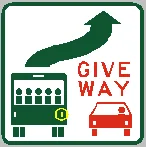
You are driving in a 60 km/h zone, with only one lane for traffic in your direction. You see a bus ahead (with this sign displayed on the rear) signalling its intention to pull out from a bus stop, you should -
Mark one answer · keys A to D
All the questions with answers
1. You are driving in a 60 km/h zone, with only one lane for traffic in your direction. You see a bus ahead (with this sign displayed on the rear) signalling its intention to pull out from a bus stop, you should -Official CG031
Answer: Slow down, and give way to the bus as it has priority.
This sign on the bus rear means you must give way to the bus as it signals to pull out from a bus stop, where the speed limit is 60 km/h or less. Slow down and let it merge.
2. If you see a horse and rider on the road what should you do?Official CG056
Answer: Slow down and give them plenty of room.
Horses can easily be startled by noise and speed. Slow down and give horse and rider plenty of space, and don't sound your horn.
3. You are in busy traffic and slow down for a bicycle rider. A driver behind you beeps a horn and pressures you to go around the bike and drive faster. How should you respond?Official CG089
Answer: Resist the pressure, stay calm and overtake the cyclist when it is safe.
Never be rushed by a driver behind. Keep calm, give the cyclist space and overtake only when it's safe. Speeding up or pressure causes crashes.
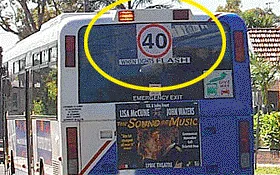
4. When you see these lights flashing on the back of a bus, what should you do?Official CG099
Answer: Drive carefully at no more than 40 km/h.
Flashing lights on the back of a bus with the 40 sign mean you must not go over 40 km/h while passing, as children could be around the bus.
5. When you see the headlights flashing on the front of a bus, what should you do?Official CG110
Answer: Be careful, there may be children about.
Flashing headlights on the front of a bus mean children may be getting on or off, so take care and be ready to slow or stop.
6. Bicycle and motorcycle riders have the same rights to use the road as other motor vehicle drivers. They are, however, more at risk in traffic because -Official CG116
Answer: They are harder to see in traffic and do not have the same protection as many drivers.
Cyclists and motorcyclists have full road rights, but they are harder to see and have little crash protection. That's why drivers must look out for them.
7. Do bicycle riders have the same rights and responsibilities as drivers and motorcycle riders?Official CG122
Answer: Yes.
Bicycle riders have the same rights and responsibilities as other road users. They must obey the road rules and are not restricted to the footpath.
8. You are driving on a road with a speed limit of 60km/h or less. How much space must you leave when passing a bicycle rider?-Official BI001
Answer: at least 1 metre.
On roads with a limit of 60 km/h or less you must leave at least 1 metre when passing a bicycle rider. Riders can wobble or swerve, so the gap protects them.
9. You are driving on a road with a speed limit above 60km/h. How much space must you leave when passing a bicycle rider?-Official BI002
Answer: at least 1.5 metres.
Above 60 km/h you need a bigger gap of at least 1.5 metres, because faster traffic is more dangerous to a rider and creates stronger air movement beside them.
10. In order to provide the minimum safe passing distance for bicycle riders, are you permitted to cross single and double continuous lines?Official BI003
Answer: yes, but you must have a clear view of any approaching traffic and it must be safe to do so.
You may cross single or double continuous lines to give a rider the minimum gap, but only when you can see approaching traffic clearly and it is safe.
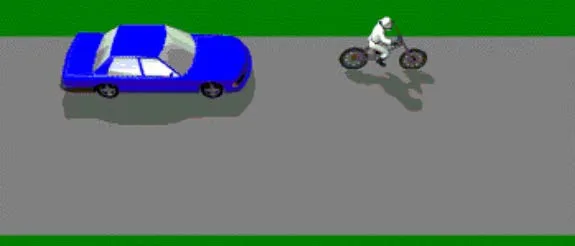
11. How should you overtake a pedal cyclist?Official ND019
Answer: The same as you would another car, with safety.
A cyclist is a road user like others. Overtake only when it is safe, leaving at least 1 m (up to 60 km/h) or 1.5 m (over 60 km/h) of space.
12. You must give way to pedestrians on a marked pedestrian crossing -Official PD001
Answer: If there is any danger of a collision.
Give way to pedestrians on a crossing whenever there's a risk of colliding, from either side. Slow down and be ready to stop.
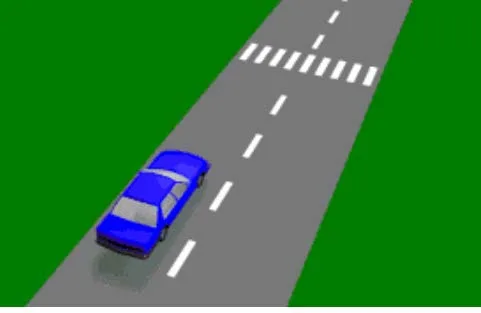
13. When approaching a marked pedestrian crossing and no pedestrians are in sight, you should -Official PD002
Answer: Slow down and be ready to make a safe stop.
Pedestrians can step onto a crossing at any moment. Slow down and be ready to stop. You don't have to stop if the crossing is clear.
14. If elderly people or children are on a pedestrian crossing you will probably need to –Official PD003
Answer: Wait extra time to allow them to cross safely.
Older people and children may cross more slowly or unpredictably. Give them extra time rather than hurrying or driving around them.
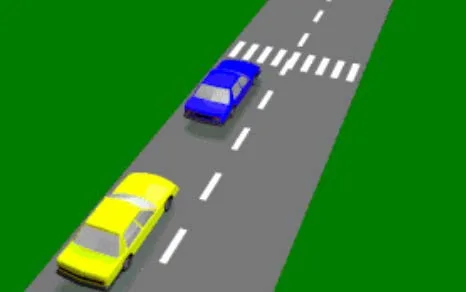
15. A vehicle ahead of you has stopped at a pedestrian crossing. You -Official PD005
Answer: Must not overtake the stopped vehicle.
The blue car has stopped at the crossing, perhaps for a pedestrian you can't see. You must not overtake it near or at the crossing, even if the crossing looks clear.
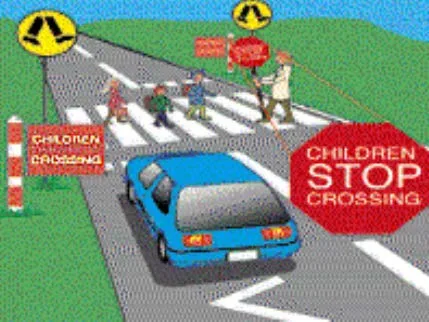
16. If you see a School Crossing Supervisor holding a sign like this, you must wait until the children -Official PD006
Answer: Are off the crossing and the hand held sign is taken away.
A supervisor holding a stop sign means you must stay stopped until all the children are off the crossing and the sign has been taken down.
17. Which one of the following statements is correct? Bicycle riders -Official PD007
Answer: Must obey the road rules.
Cyclists must follow road rules like other road users. They aren't banned from heavy traffic roads and must ride with traffic, not against it.
18. When driving near children playing or walking near the edge of the road, you should -Official PD009
Answer: Slow down, and be ready to make a safe stop.
Children can run onto the road without warning. Slow down and be ready to stop rather than speeding past or relying on your horn.
19. Pedestrians who are affected by alcohol, are -Official PD010
Answer: One of the most common groups involved in road accidents.
Pedestrians affected by alcohol are often involved in crashes because their judgement is poor. Watch out for them near roads.
20. When driving near pedestrian crossings, intersections, or school crossings, you should always -Official PD011
Answer: Slow down, watch for pedestrians and be ready to make a safe stop.
Pedestrians are most likely to cross at crossings, intersections and school crossings. Slow down and watch for them so you can stop in time.
21. When driving in an area where there are many pedestrians (e.g. a bus stop) it is important to -Official PD012
Answer: Slow down and watch for an indication that they will enter the road.
Crowds near bus stops often step out without warning. Slow down and watch for signs they're about to cross.
22. When driving past parked vehicles, which of the following is it most important to do –Official PD013
Answer: Watch for pedestrians, animals and car doors opening.
Pedestrians, animals or children can emerge from between parked vehicles. Doors can also open suddenly, so watch for them.
23. When driving in wet weather, you should -Official PD014
Answer: Watch out for pedestrians, who may hurry and take risks.
In rain pedestrians often rush, may not check for traffic and may run across. Slow down and watch for them.
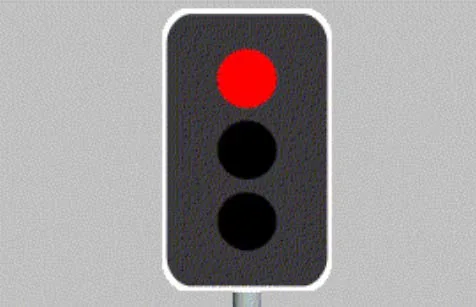
24. At a pedestrian crossing with traffic lights, when the amber light starts 'flashing' after the red stop signal, it means -Official PD015
Answer: You may carefully drive through the crossing, if there is no risk of colliding with pedestrians.
A flashing yellow after red at a pedestrian crossing means the pedestrians' phase has ended. You may proceed with care, but only if no pedestrian is still crossing.
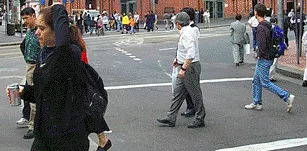
25. Which statement is true?Official PD016
Answer: You must give way to pedestrians if there is any danger of hitting them.
You must always give way to pedestrians if there is any danger of a collision, wherever they are, not just at marked crossings.
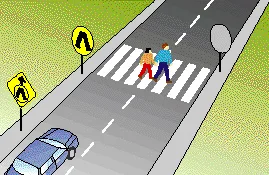
26. You drive towards these people on the road. What should you do?Official PD017
Answer: Stop and give way if there is any danger of hitting them.
Pedestrians are on the road ahead, so you must stop and give way if there is any chance of hitting them. Don't use your horn to move them or continue at speed.
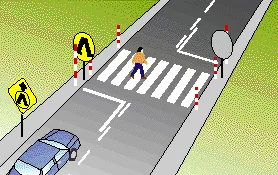
27. You approach a person crossing the road. You should -Official PD021
Answer: Slow down or stop to avoid hitting the person.
You must slow down or stop to avoid hitting a person crossing the road. Never swerve around them or use your horn to rush them.
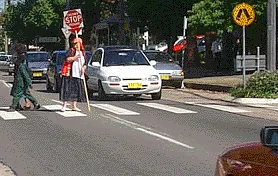
28. You approach a crossing and see the scene in the picture. You should -Official PD022
Answer: Slow down and stop until the supervisor takes down the sign.
The supervisor is holding a stop sign, so you must stop and wait until the sign is lowered and the children are clear of the crossing, in both directions.
29. At a pedestrian crossing with traffic lights, when the lights change to red you should -Official PD023
Answer: Stop, wait for pedestrians to cross and for the green light to come on.
When the lights turn red, you must stop. Wait until pedestrians have finished crossing and the light turns green before you go.
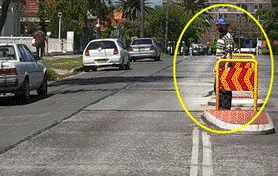
30. This person is standing on a pedestrian refuge. If he steps out onto your lane you should -Official PD024
Answer: Give way to the person if there is any danger of colliding.
The person is on the refuge and may step out. You must give way if there's a risk of hitting them.
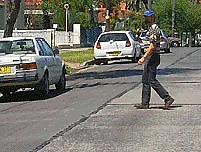
31. Which of the following statements is correct?Official PD025
Answer: You must give way to pedestrians if there is a danger of a collision.
Whenever there's a risk of a collision, you must give way to pedestrians, whether at crossings or not. Pedestrians can cross anywhere if safe.
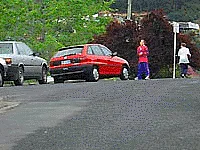
32. When you see children on or near the road -Official PD026
Answer: You should slow down and be more careful because they may move suddenly.
Children are unpredictable and can dart into the road. Slow down and take extra care so you can stop in time.
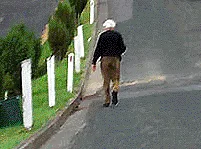
33. When you see older people on or near the road, you should -Official PD027
Answer: Slow down and take extra care because they may not see you until you are very close.
Older people may not see or hear you until you're close, and may cross slowly. Slow down and take extra care instead of honking or driving around them.
34. You must give way to pedestrians if there is a risk of hitting them. When driving in poor light, you should -Official PD028
Answer: Look more carefully for pedestrians because they are hard to see.
In poor light pedestrians are hard to see, so you must look more carefully. Using high beam all the time can dazzle others, and lane position doesn't make a difference.
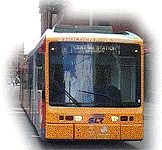
35. You drive up to a Light Rail vehicle that has just stopped at a tram stop. What is the most important thing you should do?Official PD030
Answer: Take extra care, slow down and give way to the pedestrians.
Passengers leaving a stopped tram are often on the road and may not look for cars. Slow down and give way to pedestrians.
36. You must give way to pedestrians -Official PD031
Answer: At all times, if there is any danger of colliding with them, even if there is no marked crossing.
You must give way to pedestrians whenever there is a risk of colliding with them, whether or not there is a crossing.
37. You are leaving a driveway and a pedestrian is walking along the footpath. What must you do?
Answer: Give way to the pedestrian
Drivers must give way to pedestrians when entering or leaving a driveway.
NSW Road User Handbook: Pedestrians
38. The red-orange flags are displayed at a children's crossing and a child is crossing. What must you do?
Answer: Stop and stay stopped until all pedestrians have left
When the flags are displayed you must stop before the stripes or stop line and remain stopped until everyone has left the crossing.
NSW Road User Handbook: Children's crossings
39. The car in the next lane has stopped at a pedestrian crossing. What are you not allowed to do?
Answer: Overtake the stopped vehicle
You must not overtake a vehicle that is stopping or has stopped to give way to pedestrians at a crossing.
NSW Road User Handbook: Pedestrian crossings
40. You are in the left lane when a bus at the far left of the road, indicating right and displaying a Give way to buses sign, starts to pull out. What should you do?
Answer: Give way to the bus
When the sign is displayed and you are in the left lane, you must give way to the bus as it moves in front of you.
NSW Road User Handbook: Merging and changing lanes
41. A 'Stop' sign is close to a pedestrian crossing and you have just stopped at the crossing line for pedestrians. What next?
Answer: Stop at the sign as well
If there is a Stop sign near the crossing you must stop at the sign, even if you have already stopped at the crossing.
NSW Road User Handbook: Pedestrian crossings
42. At a pelican crossing the yellow light is flashing and no pedestrians are on the crossing. What may you do?
Answer: Drive through the crossing
When the yellow light flashes you can drive through the crossing if there are no pedestrians on it.
NSW Road User Handbook: Pedestrian crossings
43. A School Crossing Supervisor is holding up a 'Stop - children crossing' sign. When can you move?
Answer: When all pedestrians have left and the sign is no longer shown
You must remain stopped until everyone has left the crossing and the supervisor is no longer showing the sign.
NSW Road User Handbook: School Crossing Supervisors
44. Why do you need extra care when reversing out of a driveway?
Answer: Pedestrians, especially children, are hard to see
Drivers cannot see people behind the vehicle well, so children in particular are at greater risk. Only reverse as far as you need.
NSW Road User Handbook: Pedestrians
45. It is dusk and raining, and you are driving past shops. What is the best approach?
Answer: Slow down and be ready to stop
Pedestrians are harder to see at dusk, at night and in rain, and they may hurry and take risks, so slow down and prepare to stop.
NSW Road User Handbook: Pedestrians
46. You are overtaking a bicycle rider on a road with an 80 km/h limit. What is the minimum gap you must leave?
Answer: At least 1.5 metres
In zones above 60 km/h you must leave at least 1.5 metres. At 60 km/h or less it is 1 metre.
NSW Road User Handbook: Bicycle riders
47. An elderly pedestrian is crossing slowly at a crossing and you are waiting. What is the right thing to do?
Answer: Give them extra time to cross
Older people may be slower and may not see you, so slow down and give them extra time to cross.
NSW Road User Handbook: Pedestrians
48. Two bicycle riders are riding side by side in front of you. When is this allowed?
Answer: When they are within 1.5 metres of each other
Bicycle riders may ride two abreast as long as they are within 1.5 metres of each other.
NSW Road User Handbook: Bicycle riders
49. Before opening your car door on the street, what must you check?
Answer: Your mirrors, for approaching bicycles
You must not open your door into the path of a bicycle, so check your rear and side mirrors first.
NSW Road User Handbook: Bicycle riders
50. A motorcycle rider is lane filtering between stopped cars. Which condition must the rider meet?
Answer: Travelling at under 30 km/h
Lane filtering is allowed for riders with a full motorcycle licence at under 30 km/h when traffic is stopped or slow and it is safe.
NSW Road User Handbook: Motorcycle riders
51. Where must a motorcycle rider not lane filter?
Answer: In a school zone
Riders must not filter next to kerbs or parked vehicles, or in school zones.
NSW Road User Handbook: Motorcycle riders
52. You come up beside a motorcycle in a lane that is wide enough for two cars. Is it fine to drive alongside it in that same lane?
Answer: No, a motorcycle has a right to a full lane
You should not drive alongside a motorcycle in the same lane, because the rider has the right to a full-width lane to ride safely.
NSW Road User Handbook: Motorcycle riders
53. You are behind a bus showing a '40 when lights flash' sign and the lights on top are flashing. What is the most you can travel when passing?
Answer: 40 km/h
You must not overtake the bus at more than 40 km/h while the lights are flashing, because children are getting on or off.
NSW Road User Handbook: Trucks and buses
54. A long truck ahead is turning left at an intersection and is swinging wide into the right lane. What should you do?
Answer: Stay behind and wait until the turn is done
Heavy vehicles can use more than one lane when turning. Placing your car in their path can be fatal, so wait behind them.
NSW Road User Handbook: Trucks and buses
55. Why should you avoid driving beside or just behind a large truck?
Answer: The driver may not see you in the blind spots
Trucks and buses have larger blind spots than cars, including in front, beside and behind them, so drivers may not see you.
NSW Road User Handbook: Trucks and buses
56. You are approaching a horse and rider on a country road. What should you do?
Answer: Slow down, leave plenty of room, and stop if the rider struggles
Horses can be unpredictable, so slow down, give plenty of room, stop if needed, and never use your horn or rev the engine.
NSW Road User Handbook: Horse riders
Questions people ask
- How far must you stay from a cyclist when overtaking in NSW?
- At least 1 metre when the speed limit is 60 km/h or less, and at least 1.5 metres when it is above 60 km/h. You may cross dividing lines to do this if it is safe.
- Can motorcycles filter through traffic in NSW?
- Yes, riders with a full motorcycle licence can lane filter at under 30 km/h when traffic is stopped or moving slowly and it is safe. They cannot filter next to kerbs or parked vehicles, or in school zones.
- What must you do at a children's crossing with flags?
- Slow down and stop before the white stripes or stop line, and stay stopped until all pedestrians have left the crossing.
- What speed must you not exceed when passing a school bus with flashing lights?
- If the bus shows a '40 when lights flash' sign and its top lights are flashing, you must not overtake it at more than 40 km/h.
Other DKT topics
- Licences and learner rules
- Penalties and demerit points
- Alcohol and drugs
- Vehicle, seatbelts and towing
- Speed and following distance
- Intersections and give way
- Roundabouts, turning and U-turns
- Lanes, overtaking and merging
- Hazards and emergency vehicles
- Parking
- Phones, distraction and fatigue
- Traffic signs and road markings
Official questions from the NSW Driver Knowledge Test question bank, © State of New South Wales (Transport for NSW), licensed under CC BY 4.0. Answer order changed; explanations by PassRank. Other questions written by PassRank from the rules in the NSW Road User Handbook (© Transport for NSW).