Vehicle, seatbelts and towing DKT practice
Part 1 and Part 2Free, no account
What you need to know
As the driver, you answer for everyone in your car. Every passenger needs their own seat with its own seatbelt, and nobody may ride in the boot, on the floor, in a ute tray or inside a trailer or caravan. You cannot carry more people than the vehicle is built for, and no part of anyone's body may poke out of a window. Passengers aged 16 or older share the duty to buckle up.
A belt only works if it is worn correctly. Think low, flat and firm: the lap section sits across your hips, the strap has no twists, and you pull it snug so the sash lies over your shoulder, not under your arm. Some people carry a medical certificate that excuses them from wearing a belt, and full licence holders may unbuckle while reversing. Learners and provisional drivers get no such shortcut apart from the medical certificate.
Children need the right restraint for their age and size. Babies up to six months go in a rear-facing seat. From six months to four years, use a rear-facing seat or a forward-facing one with a built-in harness. From four to seven, use a harness seat or an approved booster. Older children who are still too small for an adult belt should use a booster, and 145 cm is the suggested minimum height for a seatbelt alone.
Seating position matters too. Under-fours may not sit in the front of a car with two or more rows. Four to seven year olds may not either, unless the back seats are already taken by other children under seven. Never hold a child on your lap or belt yourself around them. Finally, keep the car legal: registered, roadworthy, tyres with at least 1.5 mm of tread, clear number plates, and for L and P1 drivers only a light trailer.
NSW Road User Handbook: Child car seats (child restraint) · Children in the front seat · Seatbelts · Towing · Vehicle registration · Roadworthiness · Number plates
46 practice questions
Pick an answer to see whether it is right and why.
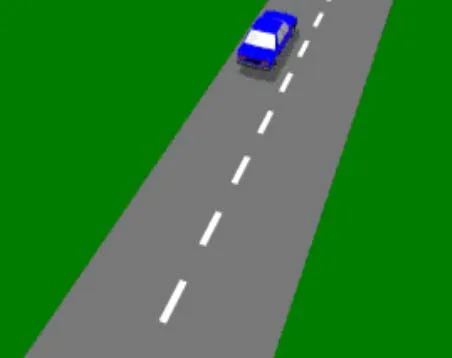
When reversing, you should -
Mark one answer · keys A to D
All the questions with answers
1. When reversing, you should -Official CG014
Answer: Take care and never reverse for a greater distance and time than is necessary.
Reversing is risky because your view is limited. Keep it as short and as brief as you can, look carefully, and keep your seatbelt on.
2. Do you have any responsibilities when opening a vehicle door on a roadway?Official CG018
Answer: Yes, you must not open a door if you are likely to cause danger to road users or impede traffic.
You must check it is safe before opening a door and not open it if it could endanger or block anyone, such as passing cyclists or cars. The driver opening the door is responsible.
3. Is it an offence to obstruct clear vision of your number plates?Official CG032
Answer: Yes, at any time.
Your number plates must always be clearly visible. Covering them, including with a bike rack or towbar, can be an offence, which is why plates can't be blocked at any time.
4. Are you permitted to drive a car towing more than one trailer?Official CG038
Answer: No, not at all.
A car can only tow one trailer at a time. Towing more than one trailer is not allowed, whatever your licence history.
5. What must you do when you are towing a caravan to help other vehicles overtake?Official CG039
Answer: Keep at least 60 metres behind heavy vehicles or other vehicles towing caravans.
A caravan makes you longer and slower to overtake. Keep at least 60 metres behind heavy vehicles or other towing vehicles so people have room to pull in safely when overtaking you.
6. Are you permitted to tow a caravan with a person riding in the caravan?Official CG040
Answer: No, not under any circumstances.
Nobody is allowed to ride in a caravan being towed. It is unsafe, with no seatbelts and no protection, and the caravan can sway or be hit.
7. Before driving a long distance at fast speed or carrying a full car load, you should -Official CG042
Answer: Check your tyre pressure, and if necessary, increase it to what the manufacturer recommends.
A full load or a long fast trip puts extra strain on tyres. Check pressure and set it to the manufacturer's recommendation, since a blowout at speed is dangerous.
8. A friend lends you his car. It is very noisy and blows a lot of smoke. He tells you the vehicle has been given a defect notice but it's still OK to drive it. What should you do?Official CG063
Answer: Before you borrow the car check the defect notice to make sure it is legal to drive the car.
Check the defect notice yourself to see what is allowed. Some defects mean the vehicle must not be driven at all, and driving it can get you fined.
9. Your car registration expires today. You have your car inspected for registration renewal but it fails the inspection. What should you do?Official CG064
Answer: After today you must not drive the car until it has been repaired, passed another inspection and registered.
Once registration runs out, the car can't be driven on the road until it is fixed, passes inspection and is registered. There is no grace period.
10. You buy a car and find that the spare tyre is smooth; the tread is only just visible. If you get a puncture will it be legal to drive the car with a smooth spare tyre?Official CG067
Answer: No, it's illegal to drive a car with a smooth tyre even if it is the spare.
Tyres must have legal tread, and that includes a spare once it is fitted. A smooth tyre grips poorly, especially in the wet.
11. You borrow a friend's car and find that the position of the driver's seat puts you sitting a long way from the steering wheel and controls. What should you do?Official CG068
Answer: Adjust the seat forward so it's right for you.
Adjust the seat so you can reach the pedals and wheel comfortably and see well. A seat set up wrongly makes you less safe, and borrowing the car doesn't change that.
12. You have a six year old child with you in your car. You have just parked so you can collect a prescription from the chemist. You should -Official CG076
Answer: Take the child with you.
Never leave a young child alone in a parked car. Cars heat up fast and a child can be at risk, so take them with you.
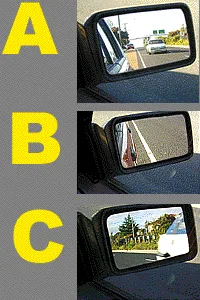
13. Which side mirror is adjusted best?Official CG087
Answer: Mirror A.
Mirror A shows a small strip of your own car and a clear view of the lane behind, which keeps blind spots small. B and C show too much car or the wrong view.
14. Before getting out of your vehicle you must -Official CG123
Answer: Check your mirrors and blind spots for pedestrians, bicycles or other vehicles.
Check mirrors and blind spots before opening your door, since cyclists, pedestrians or vehicles may be passing.
15. A car is carrying a driver and 3 adult passengers. There are seat belts in all seating positions. By law, seat belts must be worn by -Official SB002
Answer: All four people.
Everyone in a car must wear a seatbelt where one is fitted, in the front and the back. Four people means all four must buckle up.
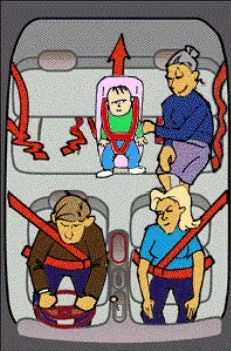
16. The adult passenger in the rear is breaking the law because she is -Official SB003
Answer: Not wearing the available seat belt.
The adult in the back seat isn't wearing the seatbelt that's fitted for her. Rear passengers must use belts, and the picture shows her belt not fastened.
17. The most effective device for protecting passengers when in an accident is –Official SB007
Answer: Seat belts.
Seatbelts are the most effective device for protecting occupants in a crash. They keep you in your seat and spread the force of impact.
18. Which one of the following statements is correct? Seat belts -Official SB008
Answer: Save lives and prevent injury.
Seatbelts save lives and reduce injuries. They are required in all seats, for all drivers and passengers, however skilled.
19. Seat belts and child restraints (eg baby capsules and child seats) -Official SB011
Answer: Must always be worn properly, and adjusted tightly.
Crashes can happen on any trip, short or long. Belts and child restraints must always be worn correctly and adjusted snugly to work.
20. Child restraints (eg, baby capsules and child seats) -Official SB012
Answer: Should be fitted according to the manufacturers' instructions.
Child restraints must be fitted as the manufacturer instructs, otherwise they may not protect the child. Holding a child in your arms is far less safe than a restraint.
21. You are driving a vehicle that only has a seat belt for the driver. To reduce the danger of being in a vehicle without a seat belt, where is the best place for passengers to sit?Official SB013
Answer: In the back seat.
Back seat passengers are generally safer than front seat ones in a crash, and sharing a belt is dangerous because two people cannot be restrained properly by one belt.
22. When passengers get in the car and do not put their seat belts on, the safest thing to do is -Official SB016
Answer: Tell them the car has seat belts and they should wear them.
As the driver you are responsible for passengers under 16 wearing belts, and it is sensible to make sure every passenger buckles up. Speaking up is the simplest way to protect them.
23. You want to give a lift to a friend and his four month old baby. Before you do, you need to make sure -Official SB017
Answer: You have a baby restraint properly fitted to your vehicle.
Babies need an approved, properly fitted and adjusted child restraint. An ordinary adult seat belt cannot protect a small baby, so a belt alone is not enough.
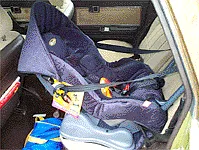
24. You want to fit a baby restraint to your car. What should you secure the restraint to?Official SB019
Answer: An anchorage point designed for a baby restraint.
Child restraints must be fixed to the car's built-in anchorage point using the restraint's own fitting. The picture shows a rear-facing baby seat secured this way, not just held by any belt.
25. You give a friend and her 12 year old son a lift. Your friend sits in the front and her son gets in the back. The boy does not put his seat belt on. By law, who has to make sure the child wears his seat belt?Official SB022
Answer: You do, because you are the driver.
The driver is legally responsible for making sure passengers under 16 wear a seat belt or proper restraint. A parent being in the car does not shift that duty.
26. Which of the following statements is correct?Official SB023
Answer: By law, all occupants of a car (unless exempt) need to be restrained by a properly fitted and adjusted seat belt or a child restraint.
Everyone in a car must be properly restrained on every trip, unless they hold a medical exemption. Airbags work together with seat belts and never replace them.
27. Who is responsible for making sure a 5-year-old passenger is in a suitable approved child restraint?
Answer: The driver of the vehicle
The driver must make sure every child under 7 is secured in an approved restraint that suits their age and size.
NSW Road User Handbook: Child car seats (child restraint)
28. What type of child car seat must a 4-month-old baby use?
Answer: A rear-facing child car seat
Babies up to 6 months must travel in a rear-facing child car seat.
NSW Road User Handbook: Child car seats (child restraint)
29. Which restraint is allowed for a 2-year-old child?
Answer: A rear-facing or harnessed child seat
Children from 6 months to 4 years must use a rear-facing seat or a forward-facing seat with an inbuilt harness.
NSW Road User Handbook: Child car seats (child restraint)
30. A 5-year-old is travelling in your car. Which option is correct?
Answer: An approved harness seat or booster seat
Children aged 4 to 7 must use a forward-facing harness seat or an approved booster seat.
NSW Road User Handbook: Child car seats (child restraint)
31. A 9-year-old is too small for an adult seatbelt. What is the suggested minimum height for using a seatbelt without a booster?
Answer: 145 cm
The handbook suggests children should be 145 cm or taller before using an adult lap-sash belt on its own.
NSW Road User Handbook: Child car seats (child restraint)
32. Your car has two rows of seats. Where may a 3-year-old in a child seat sit?
Answer: In the back row, not the front
Children under 4 must not sit in the front seat of a vehicle with two or more rows of seats.
NSW Road User Handbook: Children in the front seat
33. When can a 5-year-old sit in the front of a car that has two rows of seats?
Answer: Only when other under-7s fill the back seats
A child aged 4 to 7 may only sit in front if the back seats are already taken by other children under 7, and they must use a suitable child seat.
NSW Road User Handbook: Children in the front seat
34. You are driving a ute with a double cab. A friend asks to ride in the tray for a short trip on a quiet road. What should you do?
Answer: Refuse, as nobody may ride in the tray
Passengers must not travel in the tray of a ute, the boot, on the floor or in a trailer, whatever the speed or distance.
NSW Road User Handbook: Seatbelts
35. May you put one seatbelt around both yourself and a toddler sitting on your lap?
Answer: No, the child could be crushed in a crash
You must not put a belt around yourself and a child on your lap, because the child can be crushed in a crash.
NSW Road User Handbook: Child car seats (child restraint)
36. Which seatbelt type may be used with a booster seat?
Answer: A lap-and-sash belt or an approved harness
A booster seat must be used with a lap-and-sash belt or an approved anchored harness, never with a lap belt alone.
NSW Road User Handbook: Child car seats (child restraint)
37. How should the lap part of your seatbelt sit when worn correctly?
Answer: Low across your hips, flat with no twists
A belt should be low on the hips, flat with no twists and pulled firm, with the sash over the shoulder.
NSW Road User Handbook: Seatbelts
38. You are a P1 driver with a medical condition that makes wearing a seatbelt harmful. What do you need to be exempt?
Answer: An appropriate medical certificate
Drivers and passengers of any licence class may be exempt from wearing a seatbelt if they carry an appropriate medical certificate.
NSW Road User Handbook: Seatbelts
39. Which driver may take off their seatbelt while reversing?
Answer: A full (unrestricted) licence holder
Only full licence holders are exempt from the seatbelt rule while reversing. Learner and provisional drivers are not.
NSW Road User Handbook: Seatbelts
40. You are towing a trailer. How many trailers may you tow behind your vehicle at one time?
Answer: One trailer at a time
You must not tow more than one trailer at a time.
NSW Road User Handbook: Towing
41. You are towing a caravan on a long trip. What is true about people travelling in it?
Answer: Nobody may travel in a towed trailer or caravan
You must not have any person travelling in a trailer or caravan you are towing.
NSW Road User Handbook: Towing
42. You are driving an unregistered car and have a crash. What is the likely result?
Answer: You have no CTP cover and face severe penalties
An unregistered vehicle has no CTP cover, so a crash brings severe penalties on top of the fine and demerit points.
NSW Road User Handbook: Vehicle registration
43. When does a vehicle generally need a safety check to renew its registration?
Answer: When it is older than 5 years
Generally, vehicles older than 5 years must pass a safety check before the registration can be renewed.
NSW Road User Handbook: Vehicle registration
44. What is the minimum tread depth for your tyres, including the spare?
Answer: 1.5 mm
Tyres must have at least 1.5 mm of tread, be properly inflated and be free of cracks, bumps and uneven wear.
NSW Road User Handbook: Roadworthiness
45. You are a P1 driver. Which car are you not allowed to drive?
Answer: A car with a tuned, more powerful engine
P1 and P2 drivers must not drive vehicles with modifications that increase engine performance.
NSW Road User Handbook: Roadworthiness
46. You stick your L plates over part of your rear number plate. Is this allowed?
Answer: No, L plates must not cover a number plate
Number plates must stay readable, so they must not be covered by L plates, P plates or anything else.
NSW Road User Handbook: Number plates
Questions people ask
- Who is responsible if a child in my car is not in the right child seat?
- The driver is. In NSW you must make sure every child under 16 is in a suitable approved restraint or a properly fitted seatbelt, and fines and demerit points apply if they are not.
- Can a child sit in the front seat in NSW?
- Children under 4 cannot sit in the front of a car with two or more rows of seats. Children aged 4 to 7 cannot either, unless the back seats are filled by other children under 7. In a single-row vehicle, a child under 4 may sit in front in a suitable child seat.
- Can a learner or P1 driver tow a trailer in NSW?
- A learner may not tow a trailer or any other vehicle. A P1 driver may tow only a light trailer that weighs no more than 250 kg when empty, with a red P plate on the back of it. You may only tow one trailer at a time and nobody can ride in it.
- How deep must my tyre tread be?
- Tyres, including the spare, must have at least 1.5 mm of tread depth. They must also be inflated to the recommended pressure and free from cracks, bumps and uneven wear.
Other DKT topics
- Licences and learner rules
- Penalties and demerit points
- Alcohol and drugs
- Speed and following distance
- Intersections and give way
- Roundabouts, turning and U-turns
- Lanes, overtaking and merging
- Sharing the road
- Hazards and emergency vehicles
- Parking
- Phones, distraction and fatigue
- Traffic signs and road markings
Official questions from the NSW Driver Knowledge Test question bank, © State of New South Wales (Transport for NSW), licensed under CC BY 4.0. Answer order changed; explanations by PassRank. Other questions written by PassRank from the rules in the NSW Road User Handbook (© Transport for NSW).